
News
Subscribe to the Australian BioCommons monthly newsletter or read previous editions
International collaboration has local impact: ELIXIR comes to town
A visit by a large group of international experts presented an excellent opportunity to deepen working relationships and connections between ELIXIR and the Australian BioCommons, and to integrate Galaxy service innovations globally.

Members of the BioCommons team with ELIXIR’s Katharina Heil and Frederik Coppens. Left to right: Johan Gustafsson, Jeff Christiansen, Katharina Heil, Melissa Burke, Frederik Coppens, Christina Hall, Tiff Nelson, Ziad Al Bkhetan.
Thanks to the strong connections that have been established between ELIXIR (the European life science data infrastructure) and Australian BioCommons, a large group of research infrastructure specialists from Europe visited Australia over July and August. An ELIXIR travel grant gave the opportunity to deepen working relationships and connections between ELIXIR and the Australian BioCommons, to integrate Galaxy service innovations globally, and to enable new connections to be made. The group of 14 ELIXIR software developers, system administrators and service administrators, along with the ELIXIR Belgium Head of Node and Co-lead of the ELIXIR Galaxy Community, Frederik Coppens, and the ELIXIR Programme Manager Communities and Training, Katharina Heil, were hosted in Brisbane, Canberra and Melbourne. It's a wonderful example of why we were enthusiastic to extend our collaboration agreement to 2028.
There were many strategically important outcomes during the visit:
Katharina and Frederik accompanied BioCommons to a meeting with NCRIS representatives at the Department of Education in Canberra, which resulted in the suggestion of a potential joint session to represent the ELIXIR-BioCommons collaboration agreement at the upcoming International Conference on Research Infrastructures (ICRI 2024)
A visit to the National Computational Infrastructure by Katharina and Frederik led to discussions about ELIXIR’s possible involvement in Supercomputing Asia
Sveinung Gundersen (ELIXIR Norway) presented FAIRtracks, a new RDA working group on FAIRification of genome sequence annotations, at the Galaxy Community Conference and International Congress of Genetics. Work to incorporate the Australian Apollo service as a use case for FAIRtracks is continuing
BioCommons connected Katharina and Australian Research Data Commons’ (ARDC) Kathryn Unsworth to discuss the latest developments in Digital Research Skills Australasia (DReSA), based on ELIXIR’s TeSS (Training eSupport System)
Katharina and Frederik presented the Using FAIR by design approaches to scale the uplift of FAIR Research Data Management practices in research ARDC webinar
Katharina was an invited guest at a careers-focused fireside chat hosted by COMBINE Australia, the student subcommittee of The Australian Bioinformatics And Computational Biology Society (ABACBS)
Frederik met BioCommons’ Johan Gustafsson to continue discussing the future directions of WorkflowHub, as part of Johan’s ongoing position as joint product owner of WorkflowHub
Katharina shared her knowledge on building active communities around research infrastructure in an interactive BioCommons hosted online meeting of local scientific community builders.
The larger group participated in the Galaxy Community Conference (GCC2023) and associated events lasting 2 weeks. As described previously, the Galaxy Australia team showcased the innovations to the Galaxy Platform that they are driving at GCC2023, and the ELIXIR group’s presence provided wonderful opportunities for in-depth sharing of technical learnings and best practices that will have a long lasting impact on the overall global Galaxy project.
Galaxy Australia’s leadership has been recognised with the invitation of Gareth Price to join the Galaxy Executive Board. Intensive planning and substantial improvements to the Galaxy ecosystem were accelerated by key ELIXIR team members extending their visit, made possible by the generosity of the Galaxy Executive Board member, Ross Lazarus, who accommodated them in Melbourne.
Snapshots of the ELIXIR team’s visit:
Saskia Hiltemann co-delivered a presentation with Gareth Price (Galaxy Australia project lead) on Managing hands-on data analysis training with Galaxy
Katharina and Frederik gave an ARDC hosted webinar on Bringing FAIR Research Data Management to Researchers at Scale
Björn Grüning spoke at the BioCommons ‘BioChats’ meeting in August on Developing, deploying, and executing scientific data analyses in Galaxy and beyond.
Global biodata resources: crucial infrastructure underpinning biodiversity research
BioCommons and ARGA will present a session covering the importance of globally-connected infrastructure, its dependence on distributed resources, and its potential fragility at next month’s TDWG 2023 Conference on Biodiversity Information Standards.

The importance of globally-connected infrastructure, its dependence on distributed resources, and its potential fragility will be addressed at next month’s conference on Biodiversity Information Standards TDWG 2023.
Biodata Infrastructure within Australia and Beyond: Landscapes and horizons will be co-presented by Chuck Cook from the Global Biodata Coalition, Kathryn Hall from the Australian Reference Genome Atlas, and Jeff Christiansen from the BioCommons.
This session will characterise the worldwide biodata infrastructure (Global Core Biodata Resources (GBC) and an inventory of biodata resources). Managers of data resources and aggregators are invited to discover the context of the entire infrastructure and to explore the scope and scale of connections and dependencies with other resources; the funding sources for the resources; and the impacts arising from the funding uncertainty associated with the underlying resources.
Life science data resources are numerous, distributed and variously interconnected, forming a singular, and arguably the largest, infrastructure for global biological research. These resources are critical for guaranteeing reproducibility and integrity for life sciences research, including biodiversity studies. Sustainably funding this disseminated infrastructure is a key challenge: the GBC is working with the funders who support many of these resources to ensure long-term funding for existing infrastructure, while also channelling support to underpin future growth in data volumes and new technologies.
TDWG 2023 is a hybrid conference taking place in Tasmania between Monday 9 Oct and Friday 13 Oct. In-person and virtual registration is now open.
Diverse range of BioCommons activities on display at eResearch Australasia 2023
BioCommons staff and collaborators will be presenting a range of our activities at eResearch and are looking forward to engaging with delegates interested in information-centric research capabilities.
The 2023 eResearch Australasia Conference will take place in Brisbane from 16 – 20 October. eResearch offers delegates interested in information-centric research capabilities the chance to engage, connect, and share their ideas. Sessions will cover how information and communication technologies help researchers to collaborate, collect, manage, share, process, analyse, store, find, understand and re-use information.
A diverse range of BioCommons activities will be on show at the conference, presented by BioCommons staff and our collaborators. Please join us at the sessions below!
Tue 17 Oct
10:05 am - Presentation: DReSA – a story of continuing collaboration in skills training (Melissa Burke)
10:25 am - Presentation: Building Galaxy Labs to advance life science research (Gareth Price on behalf of Anna Syme)
2:15 pm - Birds of a Feather (BoF): Discussing the implementation of SciDir – A scientific software distribution repository for bringing reproducible software containers securely to HPCs in Australia (Greg D’Arcy - AARNet collaborator)
4:05 pm - BoF: Driving community engagement with National Research Infrastructures (Melissa Burke)
Wed 18 Oct
11 am - Presentation: Curating species lists: Aggregating data to enhance context (Keeva Connolly speaking about the soon to be launched Australian Reference Genome Atlas, ARGA)
2 pm - Presentation: Visible & reusable workflows (Johan Gustafsson)
2:20 pm - BoF: Visible research software interest group (Johan Gustafsson)
4:10 pm - BoF: Putting Babel fish in our ears – creating a language for developers to talk to infrastructure designers and users for mutual gain (Mok, Keeva Connolly, Kathryn Hall - Atlas of Living Australia collaborator)
Thu 19 Oct
12 pm - Presentation: Knitting jumpers from steel wool and spaghetti: implementing a modified Darwin Core Event model for the Australian Reference Genome Atlas (ARGA) to increase trust through provenance (Kathryn Hall)
We look forward to catching up with many of you in person at the conference!
Month-long visit of ELIXIR team to Australia
A team of 14 ELIXIR experts visited Australia for a month to coincide with the 2023 Galaxy Community Conference and were hosted by Australian BioCommons.
reposted from the ELIXIR EUROPE website

The ELIXIR team who travelled to Australia. Second left to right: Björn Grüning, Frederik Coppens, Paul De Geest, Katharina Heil, Helge Hecht, Laila Los, Helena Rasche, Saskia Hiltemann, Anthony Bretaudeau , Marie Josse, Krzysztof Poterlowicz, Katarzyna Kamieniecka and Alireza Heidari (missing, Wendy Bacon).
Over the (European) summer, a team of 14 ELIXIR experts visited Australia for a month to coincide with the Galaxy Community Conference (GCC2023), hosted by ELIXIR collaborators, the Australian BioCommons. The opportunity of GCC2023 brought Australian BioCommons partners, normally widely dispersed across the country, to a single location, and the presence of ELIXIR experts brought a European perspective to the global meeting.
On the technical level, the aims of the visit were to strengthen Galaxy system administration capacity in both Australia and Europe, share technical expertise to decrease the environmental impact of Galaxy, extend and improve the Galaxy training network, investigate the feasibility of running Pulsar as a global distributed compute network, and extend RO-Crate integration into Galaxy.
The strategic and scientific aims of the visit were to integrate biodiversity tools and workflows into Galaxy and the ELIXIR Research Software Ecosystem, align ELIXIR and European Open Science Cloud (EOSC) efforts (including EuroScienceGateway) with the plans of the Australian Biocommons, and deepen working relationships and connections between ELIXIR and the Australian BioCommons.
The ELIXIR team included software developers, system administrators and service administrators, along with the ELIXIR Belgium Head of Node (Frederik Coppens) and the ELIXIR Programme Manager Communities and Training (Katharina Heil). Funding was provided by the ELIXIR Travel Grant Scheme.
In addition to contributing to GCC2023, the ELIXIR representatives attended the Galaxy Community CoFest, ran three in-person Galaxy trainings for the Australasia community and visited Australian BioCommons partner institutions. The interactions enabled in-depth sharing of technical learnings and best practices, and provided an opportunity for strategic discussions on the newly renewed ELIXIR-Australian BioCommons collaboration agreement.
Katharina Heil and Frederik Coppens, as senior ELIXIR representatives, held discussions with representatives of the Australian Government’s National Collaborative Research Infrastructure Scheme (NCRIS), who fund Australian BioCommons. They also met with leaders from one of Australia’s two supercomputing centres, the National Computational Infrastructure (NCI), and featured in a webinar hosted by the Australian Research Data Commons (ARDC).
Björn Grüning, co-lead of ELIXIR Galaxy Community said:
“The sustainability of open source projects is dependent on collaborations and diverse contributions. Having the opportunity to work with the Australian Galaxy community across the continent has led to new ideas, projects and friendships that will have a long lasting impact on the overall global project. It's incredible how much we have learned from each other during the stay.”
Dr Gareth Price, Project Lead for the Australian BioCommons’ Galaxy Australia service commented:
“The long visit enabled fantastic exchanges between our team and ELIXIR international colleagues. Everyone is now energised and motivated to keep improving Galaxy Australia and strengthen our collaborations internationally.”
Collaboration boosts Galaxy services
The global Galaxy family has capitalised on the rare opportunity to work in the same timezone, with key members of the Galaxy Europe team remaining in Australia after attending the Galaxy Community Conference. Thanks to a working visit sponsored by ELIXIR Europe, significant progress has been made to improve the Galaxy experience.

Top left: Laila Los delivering the VueJS workshop. Top right: A short history of the Galaxy Training Network presented by Dr Saskia Hiltemann. Middle left and centre: Brainstorming sessions were held indoors… and outdoors. Middle right: Dolphin spotting! Bottom: Dr Saskia Hiltemann and Dr Gareth Price co-delivering the ‘Managing hands-on training with Galaxy’ webinar.
The global Galaxy family has capitalised on the rare opportunity to work in the same timezone, with key members of the Galaxy Europe team remaining in Australia after attending the Galaxy Community Conference. Thanks to a working visit sponsored by ELIXIR Europe, significant progress has been made to improve the Galaxy experience.
Dr Björn Grüning, Freiburg Galaxy team lead, welcomed the opportunity to work intensively with the QCIF and Melbourne Bioinformatics based teams:
“The chance to collaborate across all aspects of Galaxy in person has been extremely valuable. We’ve prioritised strategic discussions and sharing best practices over writing code, and now we have strong roadmaps for several projects planned out for the rest of 2023.”
Targets for development
The wide-ranging areas for development identified by these collaborative discussions will be rolled across Galaxy over the next 6 months - you can see the list of priorities on GitHub.
User experience improvements including:
A user-friendly workflow discovery page - directly inspired by Prof Carolyn Hogg’s GCC2023 keynote speech
“Pinboards” offering quick and project-specific access to your favourite workflows, tools and training
Direct plug-in of Galaxy Training to the user interface, offering recorded training sessions just one click away from tools or workflows
Adding funding information to the metadata included with tools, allowing tool writers to acknowledge grants that support their work
Optimisation and large dataset testing on Galaxy Australia of workflows from the Vertebrate Genomes Project, including one click imports to the Galaxy Australia Genome Lab.
The team have found the simple act of working next to each other particularly helpful. Dr Anna Syme, Bioinformatician at Melbourne Bioinformatics and the Australian BioCommons, said that:
“The small day-to-day interactions that only happen in person have been a great chance to share our favourite tips and tricks when working with Galaxy. For example, Björn shared that user preferences can be set to re-use previous jobs rather than running them again, which has sped up the testing process of job-heavy workflows and saved me a lot of time!”
Presentations
During the visit, there have also been several formalised knowledge sharing sessions from both the Galaxy Europe and Galaxy Australia team.
Managing hands-on data analysis training with Galaxy webinar by Galaxy Australia’s Dr Gareth Price and Galaxy Training leads Dr Saskia Hiltemann and Helena Rasche (both from Erasmus Medical Center, the Netherlands)
A two day workshop on VueJS (the framework that Galaxy is built on) led by Laila Los, software engineer at The University of Freiburg
Dr Björn Grüning discussed the semi-automated Planemo toolkit for developing, deploying and executing tools and workflows in Galaxy at the August BioChats meeting, and in a half-day, hands-on workshop at the Melbourne Bioinformatics office.
Keep a close eye on Galaxy Australia for improvements, and hear more about the upcoming developments by subscribing to the BioCommons newsletter.
Advice, infrastructure and support for community-scale bioinformatics training
The Australian BioCommons training team enables life science research excellence by creating opportunities to develop transferable skills in bioinformatics and to learn how to use new platforms, tools, services and techniques.

The Australian BioCommons training team enables life science research excellence by creating opportunities to develop transferable skills in bioinformatics and to learn how to use new platforms, tools, services and techniques.
The team convenes the National Bioinformatics Training Cooperative and partners with the extended Australian BioCommons network to deliver practical and accessible bioinformatics training. We connect large organisations, small facilities, collaborative initiatives and individual experts to deliver community-scale training opportunities.
Just as BioCommons forms partnerships to drive coordinated solutions to life science researchers’ problems, the training team supports specialists from our community to create training resources and events. We can support individuals and groups to share their specialist knowledge with the national community by:
Implementing a framework for virtual or hybrid training
Providing advice on training materials
Taking care of event logistics
Finding additional trainers to help with delivery
Connecting with an engaged audience
Choosing and accessing computational resources to support your training needs e.g. Galaxy Australia, Nectar Cloud.
Read more about how we work in this case study of a successful training collaboration with researchers from the Genomics for Australian Plants consortium to deliver a series of high quality, live, hands-on learning opportunities.
Get in touch to find out how we can help bring your training to a national audience training@biocommons.org.au
A new best-practice workflow for easy and efficient genome assembly
An off-the-shelf bioinformatics workflow for genome assembly from HiFi read data is now available and has been specifically tailored for Australian researchers through a collaboration between BioCommons and the Australian Genomics Research Facility.
An off-the-shelf bioinformatics workflow for genome assembly from HiFi read data is now available and has been specifically tailored for Australian researchers. The new custom-built genome assembly workflow:
Allows researchers to easily and efficiently assemble genomes from their HiFi read data
Has a full suite of supporting guides and technical documents for users to follow thanks to the experts at the AGRF and the BioCommons team
Is easily findable via WorkflowHub.
Assembling genomes from HiFi reads is a common roadblock for researchers. Now, researchers can access a customised solution following a successful collaboration between two Bioplatforms Australia facilities, the Australian Genomics Research Facility (AGRF) and the Australian BioCommons. Dr Kenneth Chan, Bioinformatics Manager at the AGRF, said that:
This custom-built genome assembly workflow provides a standardised approach that follows best practice in terms of workflow design, documentation and user support. Now when AGRF generates HiFi long read sequencing data for researchers we can direct them to this workflow solution with confidence that it will suit their needs.
The workflow is written in NextFlow and employs assembly software specific for HiFi sequencing reads. It features pre-assembly quality control for the raw sequence data, a primary assembly stage using the Improved Phased Assembler from PacBio, and a post-assembly quality control stage.

Outline of the tools and processes within the HiFi genome assembly workflow
Community scale research requires reproducible, best-practice, bioinformatics workflows that can be run on a multitude of computational systems. The new custom-built workflow has been optimised across several national research consortiums, and can run on the Gadi supercomputer at NCI Australia, the Setonix supercomputer at Pawsey, Amazon Web Services, and the in-house computational systems at the AGRF. Looking to the future, the workflow has been prepared for use on NextFlow Tower as the BioCommons and our infrastructure partners are in the process of setting up a national NextFlow Tower service.
Researchers can find the new workflow easily on WorkflowHub. If you are interested in contributing to future efforts in the workflows space, the Australian BioCommons coordinates a community for computational workflows in bioinformatics. Anyone is welcome to join the conversation and contribute!
The Australian Outpost of BioHackathon Europe is back for 2023!
Want to develop your skills while pitching in to the international effort to improve life science data infrastructure and code? Join the Australian Outpost of the BioHackathon Europe! This unique opportunity to participate in a significant global event will see you networking with your international peers while working locally on practical challenges. BioCommons will cover your expenses to join us in Brisbane for the duration of ELIXIR’s BioHackathon, 30 Oct - 3 Nov 2023.
Do you want to join this year’s BioHackathon Europe but can’t make it to Barcelona? Like we did in 2022, we’re putting together a team who will join from Australia, working with the international participants in their timezone - but from a city closer to home.

This is a unique opportunity to participate in a significant global event and network with your international peers while working intensively on practical coding challenges. We will fly you to Brisbane to work together in a hotel for the duration of ELIXIR’s BioHackathon: 30 Oct to 3 Nov 2023. Participation will require working in the evening, so we will keep the late-night hacking vibes going by linking up live with the team in Barcelona (5pm until about midnight) and enjoying Spanish foods as if we were there!
Projects we’ll be working on:
BioHackathon participation aims to:
Advance the development of an open source infrastructure for data integration to accelerate scientific innovation
Engage technical people in the bioinformatics community to work together on topics of common interest
Strengthen interactions, establish and reinforce collaborations through hands-on programming activities.
Alert us asap if you are interested in joining the Australian Outpost of the BioHackathon Europe, including which project/s would you like to participate in and why? When we get a feel for who is interested we will select a team of people and organise our meetup. No need to register for a place on the BioHackathon Europe website - they have reserved places for the Australian Outpost.
Please submit your expression of interest to christina@biocommons.org.au by close of business 11 Sep 2023.
Wrapping up the 2023 Galaxy Community Conference
We have just wrapped up the global Galaxy Community Conference for 2023. Over 130 delegates from 20 countries joined us at QUT to discuss the latest developments in Galaxy, both in person and online.
We have just wrapped up the international Galaxy Community Conference for 2023, where over 130 delegates from 20 countries joined us in Brisbane and online to discuss the latest developments in Galaxy.

GCC2023's inspiring keynote speakers shared how they use Galaxy in their important research into biodiversity and structural biology.
Dr Carolyn Hogg, University of Sydney: To infinity and beyond – combining genomics and cloud technology to save our species
Dr Kate Michie, University of New South Wales: Alphafold2 and the Age of Deep Learning - Recent advances in structural biology
A/Prof Roberto Barrero Gumiel, QUT: Improving plant industry access to new genetics through faster and more accurate diagnostics of plant viruses and viroids
Galaxy Executive Board member, Michael Schatz, who is a Bloomberg Distinguished Professor of Computer Science and Biology at Johns Hopkins University was encouraged to see that:
“The keynotes really highlighted how Galaxy enables cutting edge science.”
Galaxy Australia team members from BioCommons, Queensland Cyber Infrastructure Foundation (QCIF), University of Queensland, Melbourne Bioinformatics and AARNet presented on topics ranging from monitoring tool health to developing the recently released Galaxy Australia Genome Lab. Dr Gareth Price, Project Lead for the Galaxy Australia service, said that:
“There was fantastic exchange between our team and international colleagues, and wonderful opportunities to engage with the global Galaxy community. GCC was an exhilarating experience and it was inspiring to be surrounded by like-minded people. The team left full of energy to keep improving Galaxy Australia and strengthen their collaborations with the wider Galaxy community.”
While we were hosted by Queensland University of Technology (QUT) at their fabulous facilities at The Cube, the ability to participate remotely was a critical factor in providing a truly international conference. Although he was part of the GCC2023 Organising Committee, Dr Prash Suravajhala, Principal Scientist, Systems Genomics at Amrita University, was unable to travel from India, but was:
“Very excited and happy to be a part of GCC2023 virtually. We witnessed scintillating talks and brainstorming sessions and the virtual attendance was a treat. This was a cherishing moment for me as I guzzled the talks from early morning India time! It has created a great camaraderie.”
Following four days of presentations and training workshops, a three day Collaboration Festival (CoFest) saw participants work on solutions and enhancements in a way that is only possible when the global team comes together. Members worked together to expand the Galaxy ecosystem, with contributions to Galaxy's tool set, documentation, training materials, code base, and much more.

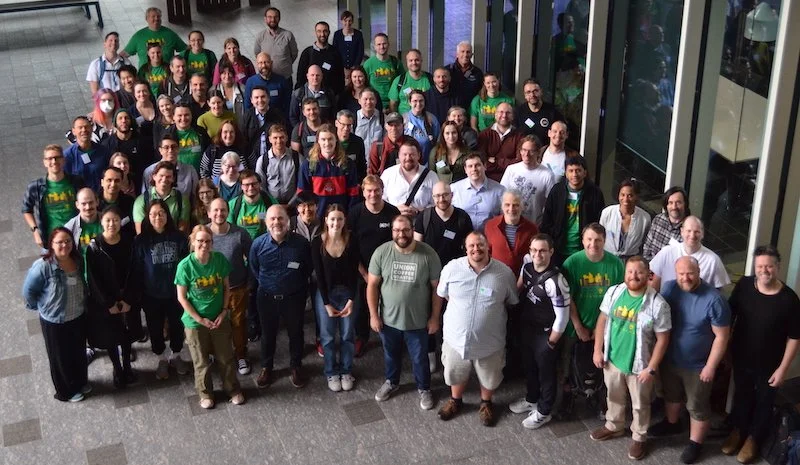
The back of the GCC2023 conference T-shirt featured a tribute to Simon.
Simon Gladman, who was an original instigator and organiser of GCC2023, would have been so proud to see his partner and kids participating in the conference. Simon was remembered with several tributes and his legacy as an innovator, role model, supporter and community connector will continue to be honoured by the renaming of the “Intergalactic Data Commission” to “Simon’s Data Club” and by an annual award in his name.
All GCC2023 presentations will soon be freely available. If you’d like to receive the notification about recordings, and keep up with plans for GCC2024 in Brno, subscribe to the BioCommons eNews or Galaxy Announcements.
Mentor program breaking down barriers with Nextflow/nf-core
With researchers continuing to have more and more data to process and analyse, Dr Georgina Samaha is aiming to break down barriers that inhibit researchers from accessing the compute resources they need during her Nextflow/nf-core mentorship.

Dr Georgina Samaha, Bioinformatics Group Lead at the Sydney Informatics Hub and BioCommons team member.
A mentorship in the Nextflow and nf-core program has been awarded to Australian BioCommons bioinformatician Dr Georgina Samaha, Bioinformatics Group Lead at the Sydney Informatics Hub. The highly competitive Nextflow/nf-core mentorship program will pair Georgie with an experienced developer to work closely on a project that she is particularly passionate about: breaking down barriers that prevent life sciences researchers from using high performance computing (HPC).
The ever-increasing scale of life sciences data means that researchers need to process or analyse their data with large-scale compute resources. This can be a daunting process, particularly for those with less experience writing code or interacting with computers on the command-line interface. Georgie plans to address these challenges:
“I will create new resources and share my learnings about Nextflow/nf-core with the broader life science research and bioinformatics communities to make their lives easier, give them a starting point and increased confidence in approaching the difficult and intimidating aspects of their work on HPCs.”
Georgie is heavily involved in improving access to command-line infrastructure for life sciences researchers as part of the BioCommons Bring Your Own Data Expansion Project. She applied to the Nextflow/nf-core mentorship program as she frequently encounters researchers who need her help to run bioinformatics pipelines on HPCs. nf-core offers community-supported reproducible pipelines that simplify data processing. These pipelines are popular in the bioinformatics community, but researchers still face challenges in using them such as understanding the resource requirements and running the pipelines efficiently. Georgie’s project aims to address these challenges to make life sciences researchers’ lives easier. She also aims to demonstrate to national HPC providers that there is significant value in improving access to large-scale compute resources for life sciences researchers.
Georgie expects that her involvement in the mentorship program will greatly increase the level of support she can offer to researchers, plus provide her valuable experience coding in Nextflow. Georgie will bring this newfound expertise to her role at Sydney Informatics Hub and the BioCommons to empower the researchers she works with, plus share her knowledge with partners including QCIF, NCI and Pawsey.
Georgie’s mentorship started in June and will run until the end of September 2023. You can find out more about the Nextflow/nf-core mentorship program at the nf-core website, and stay tuned to hear from Georgie later in the year!