Australian BioCommons Leadership Share (ABLeS)
The Australian BioCommons Leadership Share (ABLeS) enhances the capacity of life science communities to construct, maintain and gain insights from community-defined and developed data assets by providing access to infrastructure and computational resources.
This Australian BioCommons program provides computational resources, specialist expertise, and a shared repository of tools and software, tailored to support life science researchers across three areas:
Generation of valuable reference data assets eg. reference genome assemblies
Data analysis at production scale using established computational workflow approaches
Acceleration of bioinformatics software development, installation, optimisation, testing and/or benchmarking.
For more details:
See the ABLeS publication: Enabling national step changes in bioinformatics through ABLeS, the Australian BioCommons Leadership Share
Resource and process descriptions, eligibility details and contact details can be found on the ABLeS github pages.

ABLeS is co-funded by Bioplatforms Australia, National Computational Infrastructure and Pawsey Supercomputing Research Centre.
News from ABLeS
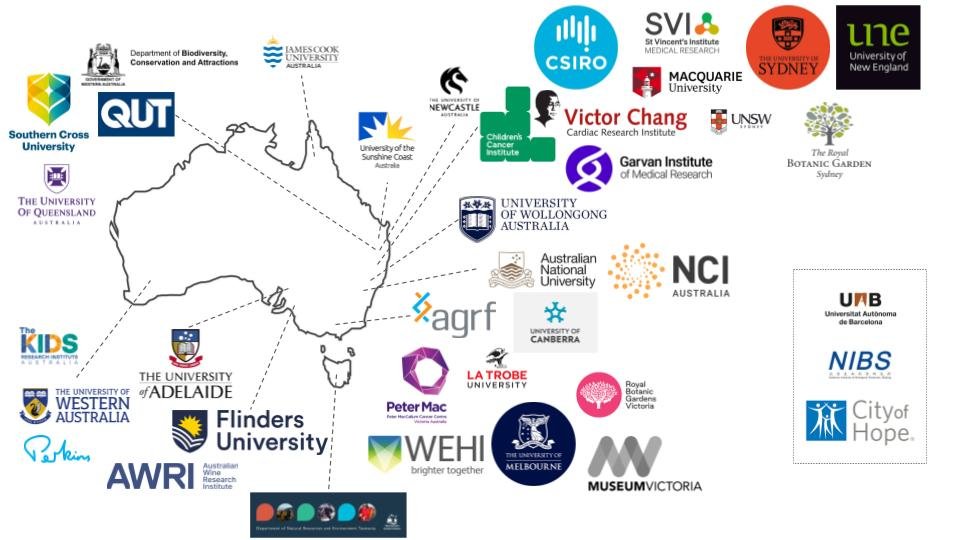
The Australian BioCommons Leadership Share (ABLeS) has been providing access to infrastructure and computational resources for over 5 years, enhancing the capacity of life scientists to readily harness national infrastructure to accelerate their discoveries. The publications generated by 73 projects involving 471 ABLeS users provide a fascinating insight into the diversity of research requiring large-scale computational power for bioinformatics.
A recent series of publications across the life sciences highlight how the Australian BioCommons Leadership Share (ABLeS) program is accelerating research across the country through streamlined access to national supercomputing resources.
Researchers investigating cancer evolution and treatment resistance have successfully leveraged ABLeS to expand their high-performance computing (HPC) capabilities. The Trigos Lab received the support they needed to formally integrate external HPC resources into their research workflows at Peter Mac.
Researchers from the ARC Centre of Excellence for Indigenous and Environmental Histories and Futures (CIEHF) have been offered access to both ABLeS and the Australian Nextflow Seqera Service to enable their vision to create a lasting impact by integrating Indigenous and Western knowledge frameworks to model environmental, cultural, and historical change in Australia over the past millennium and into the near future.
The ABLeS User Group Meetings provide opportunities to come together to share knowledge, offer tips, ask questions or give feedback.
Researchers have developed a novel solution to process nanopore sequencing data on any mainstream GPU hardware, expanding computational options for the global bioinformatics community. Slorado is the first open-source software/library solution for nanopore sequencing basecalling on AMD Graphic Processing Units (GPUs). It was developed using Australia’s most powerful supercomputer at the Pawsey Supercomputing Research Centre with the support of the Australian BioCommons Leadership Share (ABLeS).
Australian researchers from the International Cannabis Genomics Research Consortium (ICGRC) have developed a web portal that is freely available for the global cannabis research community to use.
What do the human respiratory virome and mediterranean diets have in common?
They’re both research programs at The Kids Research Institute that are being supported by the Australian BioCommons Leadership Share.
Researchers from the Museums Victoria Research Institute have constructed one of the largest distributional and evolutionary DNA datasets seen in marine science and now seek to answer questions such as: Where and when did deep sea life begin? How did it spread throughout the oceans that cover over 70% of the Earth’s surface?
We spotlight how several Australian researchers are leveraging ABLeS in their work across the life sciences.
Learn more the dedicated ‘Bio Day’ at SCA, which focused on the intersection of biology and computing.
Australian BioCommons has entered into an access agreement the Pawsey Supercomputing Research Centre boosting access to high end supercomputing for life science research nationally.