
News
Subscribe to the Australian BioCommons monthly newsletter or read previous editions
Australian meeting strengthens international ties in human genomics
A rare opportunity to meet face-to-face saw a global collective of human genome informatics organisations gather to discuss common interests, challenges, and opportunities.
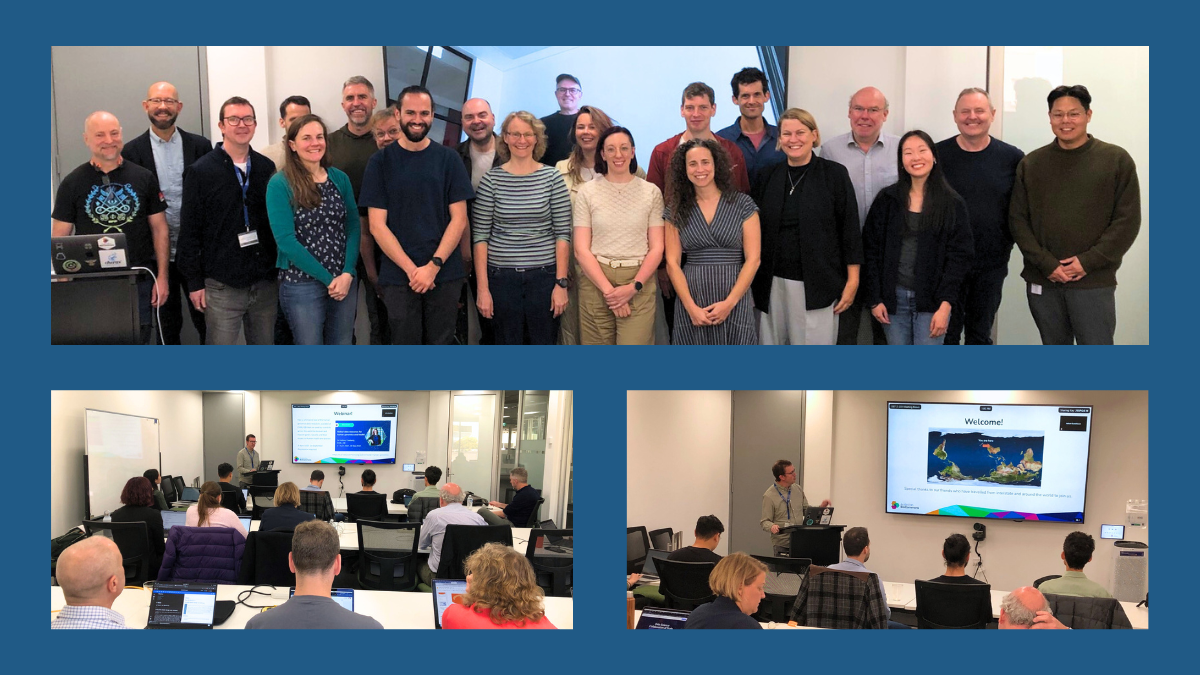
Australian BioCommons recently brought together a global group of research infrastructure specialists working at the forefront of genomics data sharing and management. Seizing the rare opportunity to meet face-to-face created by the GA4GH Plenary held in Melbourne, members gathered to explore shared challenges, common interests and opportunities to deepen ties for mutual benefit.
The organisations and projects represented included:
Australian BioCommons
EMBL's European Bioinformatics Institute (EMBL-EBI)
The two day meeting opened with presentations detailing the genomics landscapes in Europe, Canada and Australia, showcasing the tools and techniques deployed by each organisation. These presentations uncovered significant convergence on technology solutions across the globe. Dr Mallory Freeberg, Human Genomics Team Lead at EMBl-EBI, noted that:
The chance to meet in person made it abundantly clear that challenges faced in human genomics are shared worldwide, and that we can learn so much from each other through our collaborations. The meeting significantly strengthened our existing relationships, and I look forward to continuing to grow our global human genomics community.
The Australian BioCommons Human Genome Informatics team relished the chance to dive into the finer details. Discussions around common technology solutions, such as GA4GH’s Beacon for handling data discovery, and using metadata standards like HPO and OMOP, were a clear standout that the team will apply to their ongoing work. Dr Conrad Leonard, Technical Lead of the Human Genome Informatics team, said:
I’m very excited for the potential of future collaborations. The opportunity to partner with the worlds’ leading scientists and technologists in this space is invaluable in our efforts to deliver genomic data sharing solutions for Australian researchers.
Overall, the meeting strengthened connections between Australian, European, and North American human genome informatics organisations, and set the stage for potential future partnerships that will drive research progress through provision of critical research infrastructure.
Read more about Australian BioCommons’ human genome informatics activities.
New high-capacity multi-omics platform attracts MRFF Critical Infrastructure funding
Australian BioCommons is part of a powerful new collaboration to build critical national research infrastructure that addresses unmet clinical needs through new discovery and diagnostic capability in multi-omics.

Australian BioCommons is part of a powerful new collaboration to build critical national research infrastructure that addresses unmet needs through new discovery and diagnostic capability in multi-omics. $15.83M of combined funding will support creation of the OMIX3 Platform, which will deliver integrated proteomics, lipidomics and metabolomics analysis of biological samples.
Significant co-investment from partners including Bioplatforms Australia, Thermo Fisher Scientific and the University of Melbourne was complemented with funding from the Australian Government’s Medical Research Future Fund’s Critical Research Infrastructure initiative. The development of this world-leading multi-omics platform will expand existing NCRIS-funded infrastructure and leverage an outstanding collaborative network of researchers, clinicians and commercial partners.
The OMIX3 Platform will be an integrated high-throughput, multi-omics facility for processing clinical samples, from point of collection and biobanking, through to comprehensive, proteomic, metabolomic and lipidomic analysis on parallel mass spectrometry platforms. Australian BioCommons’ Human Genome Informatics team will contribute their extensive experience in developing sensitive data storage, sharing and analytics capabilities.
Led by the University of Melbourne’s Professor Olivia Carter, the OMIX3: High-capacity integrated multi-omics project includes partners and collaborators from Melbourne School of Psychological Sciences, Murdoch Children’s Research Institute, Melbourne School of Biomedical Sciences, Melbourne Dental School, Thermo Fisher Scientific, Australian BioCommons and Bioplatforms Australia.
You can learn more about the project by reading these announcements from other partners:
MRFF funding for Australia-first research infrastructure project (Melbourne School of Psychological Sciences, the University of Melbourne)
Researchers awarded $36m funding from MRFF for projects across health and science (the University of Melbourne)
Community-led design helps create Galaxy Australia’s Proteomics Lab
Proteomics Lab offers a customised, user-friendly view of Galaxy Australia that provides rapid access to a range of sophisticated proteomics resources alongside the compute proteomics researchers need.

Galaxy Australia’s Proteomics Lab interface.
The new Galaxy Australia Proteomics Lab is now offering a customised, user-friendly view of Galaxy Australia that provides rapid access to a range of sophisticated proteomics resources alongside the compute proteomics researchers need.
Analysing proteomics data within Proteomics Lab is a smooth experience, with common tools conveniently sorted into categories. Each tool comes with descriptions and examples of required inputs, and includes links to tutorials and support. There’s also pre-organised test data available for key tools, making it faster to get started!
The Australian Proteomics Bioinformatics Community championed the development of Galaxy Australia’s Proteomics Lab, sharing their needs in quarterly meetings, including an in-person community forum held earlier this year. Assoc Prof Matt Padula, Director of the Lipidomics and Metabolomics Core Facility within the School of Life Sciences and Proteomics at University of Technology Sydney, and proteomics community member, found the community-led design approach particularly valuable:
It’s helped us realise the breadth of requirements from researchers with varying levels of proteomics knowledge. This field's complexity has led to misunderstandings about its capabilities and how to analyse data effectively. We’ve been able to design Proteomics Lab to assist researchers analyse proteomics data appropriately, with rapid access to guidance.
Matt expects Proteomics Lab will particularly benefit researchers who are beginning their proteomics journey:
The Lab will be an efficient training tool for both researchers and coursework students learning proteomics. It provides a lower barrier to entry, and the interfaces are streamlined compared to those of the desktop versions of the software, hiding complicated and potentially unnecessary settings that should often be left alone.
Proteomics Lab pairs perfectly with the computing power of Galaxy Australia, which is underpinned by computational resources provided by AARNet, ARDC Nectar Research Cloud, the University of Melbourne, QCIF, Pawsey Supercomputing Research Centre, National Computational Infrastructure, and Microsoft Azure. Access to this fully-subsidised compute via the Galaxy Australia Proteomics Lab is expected to improve efficiency for researchers using proteomics services like those accessing Matt’s Facility:
Now researchers at my Facility won’t have to wait for desktop computers to become free, and facility staff won’t have to manage access, freeing up everyone’s time.
Proteomics Lab is the latest release in a series of Labs that support different research domains. If you are an Australian researcher with an interest in proteomics, be sure to try out the new Galaxy Australia Proteomics Lab now!
The Australian Nextflow Seqera Service: Your one-stop shop for Nextflow workflows
The new service provides access to a centralised command post for Australian researchers to manage, launch and monitor their Nextflow workflows.

A new service provides access to a centralised command post for Australian researchers to manage, launch and monitor their Nextflow workflows. This subsidised access to Seqera Platform is now available through a licensing agreement between Seqera and Australian BioCommons.
Researchers can run workflows on the Australian Nextflow Seqera Service using their existing allocations at their preferred compute infrastructure, including local high-performance computers (HPCs) or commercial cloud services. Alternatively, national compute resources at Tier 1 facilities are available through the complementary Australian BioCommons Leadership Share (ABLeS). Dr Magdalena Antczak, Bioinformatician at QCIF, found this connection particularly helpful:
Thanks to the resources allocated to us by the ABLeS program, we were able to launch the ONTViSc pipeline detecting viruses from plants from within the Australian Nextflow Seqera Service. We could test the pipeline thoroughly using multiple high-performance computing infrastructures and cater for users without easy access to bioinformatics services.
Out-of-the-box configurations for running Nextflow pipelines on Pawsey Supercomputing Research Centre’s Setonix and National Computational Infrastructure’s (NCI’s) Gadi are available. Or if research groups need a more bespoke approach, extensive technical documentation and the friendly user guide will help tailor the Australian Nextflow Seqera Service to their needs.
Dr Julie Iskander, Lead Research Computing Engineer at WEHI, has seen the benefits for researchers first hand:
WEHI’s Research Computing Platform Engineering team supports WEHI researchers through software engineering services to build tools and pipelines. Seqera Platform has helped us a lot. We've been able to invite our researchers to jump in and see if the platform meets their needs. With the support of the BioCommons, we've had 15 researchers across 7 of our different research groups try it out. It's made launching pipelines easy for researchers who are not familiar with linux systems and command line. This helps them to independently run complex workflows on the HPC, with minimum knowledge of its underlying complexities.
WEHI was one of the 33 groups across 16 Australian research institutes taking part in BioCommons’ successful two-year pilot program, supported by Pawsey, NCI, Sydney Informatics Hub, Queensland Cyber Infrastructure Foundation (QCIF) and the University of Melbourne. Over that time, Seqera worked with BioCommons to understand how to best support the local Nextflow community and match Australian researchers’ sophisticated usage of the workflow management and data analysis environment, Seqera Platform.
The Australian Nextflow Seqera Service is fully subsidised for groups of up to three users to work collaboratively in a dedicated workspace. Larger organisations can explore the service at no cost by bringing an unlimited number of users to their dedicated workspaces for their first year of use (annual fee applies thereafter).
The Australian Nextflow Seqera Service is a key component of BioCommons’ vision to build an ecosystem of data analysis infrastructures that empower breakthrough discoveries.
Find out more about the Australian Nextflow Seqera Service and register to get started today!
The Australian Nextflow Seqera Service is operated by Australian BioCommons in collaboration with Pawsey, NCI, and Seqera. It is hosted on Amazon Web Services and supported by Bioplatforms Australia via NCRIS funding.
Attend AMSI’s BioInfoSummer with support from Australian BioCommons
Australian BioCommons is once again supporting undergraduate and postgraduate students from around the country to travel to AMSI BioInfoSummer in Melbourne.

Australian BioCommons is once again supporting undergraduate and postgraduate students from around the country to travel to AMSI BioInfoSummer in Melbourne.
Australian Mathematical Sciences Institute’s annual event brings together people from all disciplines to discuss the latest research and developments in bioinformatics. This flagship conference is well known for connecting those new to bioinformatics research with leading experts, and enabling cross-disciplinary networking under a shared interest in bioinformatics.
AMSI BioInfoSummer is being held at the University of Melbourne with three themes: whole-cell modelling, machine learning and AI for genomics, and emerging technologies. The emerging technologies theme includes a two-part workshop ‘Hello Nextflow!’ presented by Australian BioCommons and our Sydney Informatics Hub Node at the University of Sydney.
Previous attendees have described BioInfoSummer as “action-packed lectures and hands-on workshops from the best in the bioinformatics field, from Australia and abroad.”
If you’re an undergraduate or postgraduate student who could benefit from full or partial travel and accommodation funding to participate in the December conference, apply before 14 October!
BioCommons features in the National Digital Research Infrastructure Strategy
The National Digital Research Infrastructure Strategy outlines priority outcomes to ensure Australian researchers continue to have access to cutting-edge research infrastructure, and features Australian BioCommons as a key case study.

The Australian Government Department of Education has published its 2030 vision for ensuring that Australian researchers maintain access to cutting-edge research infrastructure. The document features Australian BioCommons, describing how three BioCommons activities are addressing national priorities.
The National Digital Research Infrastructure (NDRI) Strategy identified six priority outcomes to achieve the NDRI vision. By 2030, Australia’s system should be:
1. Underpinned by training frameworks for researchers and the NRI workforce.
2. Responsive to technological and societal shifts.
3. Consistent in its standards for data collection, curation, and access.
4. Integrated across levels of computing and data infrastructure.
5. Cybersecure, particularly for national-scale data and computing.
6. Maximised by openly available research software tools.
The Strategy highlights how Australian BioCommons, in our role as the bioinformatics capability of Bioplatforms Australia, are taking up the challenge of training researchers and the NDRI workforce. It notes the high level of engagement in our training program and links this to the recruitment of NDRI users. Looking forward, the NDRI strategy calls for ‘the NDRI system [to be] underpinned by training frameworks for researchers and the NRI workforce,’ citing the importance of existing activities such as DreSA, another activity that BioCommons has proudly supported.
The Australian AlphaFold Service was highlighted as a notable example for the second priority outcome that ‘the NDRI system should be responsive to technological and societal shifts.’ The service represents a national infrastructure level response to the technological shift caused by the rise of Google DeepMind’s AlphaFold technology. AlphaFold is already accelerating research fields that rely on protein structures, such as drug discovery, vaccine design or resilient crop development, with predicted structures available in just minutes compared with existing slow, laborious experimental techniques. The Australian AlphaFold Service takes care of the set-up and provisioning of underlying infrastructure so researchers can focus on rapidly generating their protein 3D structures through AlphaFold. The service is delivered by BioCommons in partnership with the Queensland Cyber Infrastructure Foundation and the University of Melbourne.
A collaboration between Australian BioCommons and the Australian Access Federation was highlighted in the Strategy as a key example of ensuring that Australia’s NDRI remains cybersecure. The collaboration delivered a candidate solutions report to guide approaches to federated identity and access management in both the Human Genomes Platform Project, and for future research infrastructures to apply. Work in this space is ongoing, with access management solutions being deployed across the BioCommons Human Genome Informatics program.
An independent working group has been formed and will now take community input to develop investment plans, which are expected to be released in 2025.
Read the full National Digital Research Infrastructure Strategy on the Department of Education website.
Australian BioCommons is enabled by Bioplatforms Australia via National Collaborative Research Infrastructure Strategy (NCRIS) funding.
Advancing the Nextflow conversation: Connect with Seqera’s Lead Developer Advocate in Melbourne
Dr Geraldine Van der Auwera is visiting Melbourne in September to support Australia’s activities around Nextflow and Seqera Platform and connect with users.

Dr Geraldine Van der Auwera, Lead Developer Advocate at Seqera, is visiting Melbourne in September to strengthen ties and support the growth of bioinformatics activities in Australia. She will meet with key stakeholders and deliver a public webinar to share the latest technical innovations and opportunities to engage with Nextflow and Seqera Platform (formerly Nextflow Tower).
The ongoing relationship between Australian BioCommons and Seqera is uplifting Australian researchers to access and deploy Seqera’s products, including Nextflow and Seqera Platform. Geraldine is visiting Melbourne to discuss future Nextflow-related activities with BioCommons and the Australian Nextflow Ambassadors, Dr Georgie Samaha and Dr Ziad Al Bkhetan. They want to know if an informal Australian Nextflow network would benefit life scientists and bioinformaticians. Share your thoughts by filling out a brief survey: Assessing interest in an Australian Nextflow network.
You can hear more from Geraldine when she delivers a BioCommons webinar Building the future of bioinformatics with Nextflow: Technical innovation, community engagement, and career development opportunities on 19 Sep 2024. You can also meet with Geraldine in spare moments around her GA4GH Plenary attendance. Please email comms@biocommons.org.au if you would like to be connected.
P.S. If you’re looking to get hands-on with Nextflow, apply to join the Hello Nextflow! workshop on by 10 September. This workshop is being offered by BioCommons, Seqera and the Sydney Informatics Hub.
New resources power long-running workflows at Pawsey Supercomputing Research Centre
In response to community requests, new resources supporting cutting edge bioinformatics workflows are available on Pawsey’s Setonix supercomputer.

Pawsey’s Setonix supercomputer (supplied by Karina Nunez).
Specialised nodes are now available at the Pawsey Supercomputing Research Centre that are designed to power long-running scientific workflows. Responding to researcher demand, new Workflow Nodes have been custom built on Setonix to optimise and support workflows managed by tools like Nextflow and Snakemake that surpass the regular 96 hour wall-time constraint.
Researchers voiced their challenges in running long workflows, including numerous reports from the BioCommons computational workflows community that they were running out of wall-time - the clock time it takes for a computation to run from start to finish. One of these researchers was Lauren Huet, Bioinformatics Research Officer at the Minderoo OceanOmics Centre at UWA:
Our Ocean Genomes project is addressing a key gap where over 95% of marine vertebrates lack sequenced genomes. Building such a comprehensive reference genome library requires intensive compute power, and the workflows can be quite long. This project would not be possible without the capacity to scale up to process tens or hundreds of genomes in parallel.
Dr Sarah Beecroft, Life Sciences Supercomputing Specialist at Pawsey, led the team effort to build dedicated Workflow Nodes on Pawsey’s Setonix - the most powerful research computer in the Southern Hemisphere.
Setonix’s Workflow Nodes provide a stable and robust environment for workflow orchestration. Users can launch their master jobs interactively and keep their sessions alive for extended time periods, enhancing both productivity and performance. I’m really excited to see the new research that is enabled!
Lauren and the OceanOmics team are already benefiting greatly from the Workflow Nodes:
It’s been a game-changer for our research! The nodes enable us to run Nextflow pipelines directly in the terminal, offering unparalleled flexibility for developing and testing our workflows. The capability to execute long-running pipelines without interruptions has significantly increased our throughput, allowing us to produce results faster and more efficiently.
As a member of the BioCommons BioCLI project, Sarah is passionate about making command-line infrastructure accessible and well documented. Together with other supercomputing experts, the team has produced a new comprehensive technical user guide for users looking to run their workflows on the Setonix Workflow Nodes.
Learn how to run workflows on the Workflow Nodes in Pawsey’s user support documentation, or join the next meeting of the BioCommons computational workflows interest group to influence future research infrastructure developments.
Supercomputing access powers paediatric research
What do the human respiratory virome and mediterranean diets have in common?
They’re both research programs at The Kids Research Institute that are being supported by the Australian BioCommons Leadership Share.

Dr Patricia Agudelo-Romero presents a poster at the 2024 AAAI conference (supplied).
Demand for high performance supercomputing resources among life scientists is increasing thanks to consistent growth in both the scale and complexity of omics datasets and analyses. The Australian BioCommons Leadership Share (ABLeS) offers a specifically tailored mix of infrastructure and computational resources to support life sciences research, providing an alternative access mechanism to Tier 1 resources outside of onerous merit-based applications.
The Kids Research Institute Australia, formerly Telethon Kids Institute, is a great example of the support ABLeS provides to research groups. As a word-class paediatric research centre, The Kids is committed to improving children’s health across its 4 key research themes: Indigenous Health, Brain and Behaviour, Chronic and Severe Diseases, and Early Environment. Many of its programs require sophisticated computational biology tools and resources, including the P4 Respiratory Health for Kids team. The P4 team focuses on the significant healthcare burden of childhood respiratory diseases, with around 20% of Australian children developing recurrent respiratory disorders such as wheezing and asthma.
Dr Patricia Agudelo-Romero, Senior Research Fellow, leads the computational biology and bioinformatics arm of the Wal-yan Respiratory Research Centre within The Kids and is a key member of the P4 team. She uses ABLeS resources to conduct omics analyses including epigenetics, transcriptomics and metagenomics. Patricia and the P4 team recently presented two studies enabled by ABLeS - understanding the methylation landscape of in utero programming in relation to asthma risk factors (part of the AERIAL study), and exploring the complexity of the human respiratory virome. The methylation study was a featured poster at the 2024 American Academy of Allergy, Asthma & Immunology conference, while the lung virome work won best selected talk at the Microbiome Virtual International Forum in 2022, having uncovered a high diversity of bacteriophages in the airways, which may play an important role in modulating the lung ecosystem.
ABLeS enabled both our studies to process more than 2,300 FASTQ files from targeted high-throughput methylation sequencing and shotgun metagenomics experiments, using two methylation-related nextflow pipelines and one related to virus discovery. These large-scale and computationally demanding analyses would not be possible without cutting-edge resources like our access to the Pawsey Supercomputing Research Centre provided through ABLeS.
In alignment with the open-science principles of ABLeS, Patricia has made her nextflow pipelines publicly available through the nf-core community - namely the EVEREST for viral assembly and characterisation, and target-methylseq-qc which performs downstream analyses after running a standardised nf-core methylseq pipeline. The same nf-core pipeline is being applied in another project at The Kids Institute, where the Clinical Epigenetics team are analysing whether a mediterranean diet induces DNA methylation changes in pregnant women as part of the ORIGINS study. ABLeS is enabling the team to run the methyl-seq pipeline, including ensuring the pipeline can be run on the upcoming Australian Nextflow Seqera Service.
Could your research team benefit from what ABLeS offers? Watch Dr Ziad Al Bkhetan give an overview of the service.
Video tutorial simplifies sharing of bioinformatics tools
Do you write or maintain bioinformatics tools? Make them accessible to the extensive Galaxy user base by following along with the new Getting Tools into Galaxy videos.

Thousands of bioinformatics tools from across the entire omics spectrum are available within Galaxy’s user-friendly web interface. New guidance videos developed by the Galaxy Australia team are supporting anyone with a little bit of coding know-how to add their favourite tools into the global Galaxy platform.
With over 11,000 individual users accessing Galaxy every month, there are frequent requests to add new tools that cater to an ever expanding array of research needs, and there is often a backlog of tools waiting to be ‘wrapped’ for use in Galaxy. The vibrant community of contributors who maintain Galaxy are passionate about open source and accessible science, and invite all tool developers, researchers, and research communities to add bioinformatics tools to Galaxy.
Galaxy Australia’s Dr Cameron Hyde and Michael Thang have prepared two new videos that explain and demonstrate the tool wrapping process to help anyone prepare tools for inclusion in Galaxy workflows across the globe.
In part one, Michael introduces the Galaxy platform, explains the process of wrapping tools for Galaxy and describes the tool parameters that can be incorporated into the underlying code (XML). Then in part two, Cameron steps through the process for building an XML wrapper to add a tool to Galaxy using Planemo. To get the most out of the tutorial, you’ll need to have a basic understanding of Linux command line (Bash) and XML syntax, and be comfortable working with a code editor. These videos complement the extensive documentation available in Planemo and the Galaxy Training Network.
If there is a tool missing from your Galaxy workflow, or you’d like to make your own tools available to a global audience, start wrapping with the Getting tools into Galaxy videos!