News
Subscribe to the Australian BioCommons monthly newsletter or read previous editions
Building bridges for better data sharing: ENA experts empower Australian researchers in data submission
A visit from the European Nucleotide Archive (ENA) team enhanced Australian researchers’ skills in submitting and retrieving genomic, metagenomic, and environmental DNA (eDNA) data to/from international repositories. The two weeks together provided a unique opportunity to engage directly in our time zone through an intensive series of workshops and roundtable discussions.

Participants of the in-person roundtable came from around Australia to meet the ENA team
For two weeks in March and April 2025, Australia’s life sciences community had a unique opportunity to engage directly with the European Nucleotide Archive (ENA) team. In a first-of-its-kind initiative, Dr Joana Pauperio (Biodiversity Curator, European Nucleotide Archive, EMBL’s European Bioinformatics Institute) and Maira Ihsan (User Support Bioinformatician, European Nucleotide Archive, EMBL’s European Bioinformatics Institute) visited Australia to deliver an intensive series of seven workshops and four roundtable discussions, aiming to enhance Australian researchers’ skills in submitting and retrieving genomic, metagenomic, and environmental DNA (eDNA) data to/from international repositories.
Organised by Australian BioCommons, the visit built technical capacity and opened a direct dialogue between the ENA and the Australian research community about the future of data submission, retrieval, and brokering. High-quality data submission to international archives like the ENA ensures that Australian-generated genomic and environmental data can contribute to global research efforts. Yet, challenges in submission processes, metadata preparation, and understanding of repository workflows can act as barriers. Bringing ENA experts together in person allowed Australian researchers to receive tailored, hands-on guidance, overcoming time zone challenges and helping the ENA team witness firsthand the hurdles local researchers face.
Workshops: Hands-on learning and capacity building
Across six data submission workshops, participants learned various data submission pathways (e.g., via Webin-CLI, programmatic, and command line) to submit:
Raw reads, genome assemblies, and annotations
Metagenome-Assembled Genomes (MAGs)
Environmental DNA (eDNA) data
A data retrieval workshop provided an opportunity for participants to practice retrieving different data types from the ENA using various tools and protocols.
Feedback was welcome at all times by providing a living document for queries that were addressed during and after the workshop, and breakout rooms for 1:1 discussions were available.
Roundtables: Listening to the community
One in-person and three online roundtable discussions were also hosted to facilitate direct communication between ENA and Australian researchers.
In-person Roundtable
This meeting between invited members of Bioplatforms Australia, Bioplatforms Australia Data Portal, Australian Reference Genome Atlas (ARGA), the Australian Tree of Life project, and the ENA teams focused on information exchange and potential collaboration in the global biodata landscape. Key topics included data brokering to ENA, species taxonomy, and the possibility of establishing an Australian node within the International Nucleotide Sequence Database Collaboration (INSDC). The immediate next step identified was to further explore data brokering. The roundtable provided a valuable forum for discussing opportunities and challenges in collaborating with the ENA and enhancing Australia's contribution to international data repositories.
Genomics Roundtable
The meeting facilitated discussions on topics including Genome assembly and annotation efforts at scale in Australia, ENA's role as a global repository and challenges in annotation submissions to INSDC. It aimed to improve understanding of data publication options and ENA submission processes.
MAGs Roundtable
The meeting facilitated discussions on topics including the use of MAGs in Australia, the role of ENA+MGnify as a global repository, challenges in mass submission of MAGs, issues with submitting MAG data for organisms not represented in the NCBI Taxonomy, and suggestions for improvement.
eDNA Roundtable
The meeting facilitated discussions on topics including eDNA use across various sectors, Australian eDNA reference library initiatives like the National Biodiversity DNA Library (NBDL), making eDNA data FAIR (Findable, Accessible, Interoperable and Reusable) and the ENA as a global repository for eDNA data, data interoperability between resources, and data sharing with third-party platforms like GBIF.
Looking ahead
The momentum generated by the workshops and roundtables will continue through:
The creation of self-paced training materials: by converting the workshop content and hosting it on the EMBL-EBI training website to ensure researchers have access to training when they need it
Efforts to explore an Australian data brokering pathway as part of the Australian Tree of Life (AToL) project
Strengthened connections between Australian researchers and INSDC repositories
By bridging expertise across continents, the collaboration between ENA and the Australian life sciences community is helping ensure that Australian research continues to have a strong, visible impact on the global stage.
Australia's inaugural nf-core Hackathon Outpost boosts local Nextflow capability
The first-ever Australian satellite site of the international nf-core Hackathon has just taken place in Sydney. Seventeen participants from across the country came together to collaborate on cutting-edge Nextflow projects. This marked a significant step in strengthening Australia’s Nextflow and nf-core community, fostering new collaborations between researchers, bioinformaticians, and Nextflow enthusiasts.

The first-ever Australian satellite site of the international nf-core Hackathon has just taken place in Sydney. Seventeen participants from across the country came together to collaborate on cutting-edge Nextflow projects. This marked a significant step in strengthening Australia’s Nextflow and nf-core community, fostering new collaborations between researchers, bioinformaticians, and Nextflow enthusiasts.
International registrations for the 2025 nf-core Hackathon almost reached 1000, with about half opting to join remotely and the remainder spread across 44 sites globally. The organisers were thrilled to finally have an Australian site. Thanks to our time zone, we were among the first to kick off each day of asynchronous work, along with colleagues across the ditch in Aotearoa New Zealand.
Australian BioCommons arranged for key participants including multiple Nextflow Ambassadors from multiple cities to join our local hosts, Sydney Informatics Hub at the University of Sydney. Participants represented Pawsey Supercomputing Research Centre, National Computational Infrastructure, Peter MacCallum Cancer Centre, QCIF, Queensland University of Technology, Sydney Informatics Hub, University of NSW, and Australian BioCommons.
The group spent three days at Moore College, a fantastic venue with an open workspace and an expansive terrace with city views - providing an ideal setting for focused work, brainstorming, and cross-team collaboration. While the hackathon was all about accelerating nf-core developments, it was also a valuable chance for collaboration outside of participants’ regular networks. Seqera sponsored our working lunches, but the Newtown cafe and restaurant scene ensured participants stayed well-fueled throughout the whole hackathon!
Over the course of three productive days the group divided up to tackle key projects in Nextflow development, including:
Working towards a new release of the nf-core ProteinFold pipeline;
Developing a Nextflow for HPC training for Australia’s national supercomputers, NCI’s Gadi HPC and Pawsey’s Setonix HPC;
A nf-test working group to write and apply unit tests to existing institutional pipelines.
As well as progressing some locally important projects, the gathering was a great opportunity to discuss Nextflow training collaborations and how we can work together to ensure more Australians can access the Nextflow skills and resources they need. Keep an eye on our training events listings to see the outcome of these new national relationships.
We are so grateful to the Seqera team and the nf-core community for their enthusiasm and efforts to welcome the Australian satellite site of the hackathon. And massive thanks to the participants who contributed their time and energy to make this event both productive and fun! With the success of this first Australian outpost, we’re already looking forward to next year’s nf-core Hackathon.
Join 41,000 users of this fully-subsidised and easy to use Australian bioinformatics platform
Galaxy has proven to be such a versatile data analysis platform that Galaxy Australia supports over 41,000 users. Now is the perfect time to get on board with Galaxy, with a variety of ways to get involved on offer in the coming months.

Galaxy has proven to be such a versatile data analysis platform that Galaxy Australia now supports over 41,000 users. This fully subsidised, open-source system for analysing and visualising data, authoring workflows, training, publishing tools, and managing infrastructure is powered by a world-wide community of 500,000 Galaxy users as well as the institutions who invest in its growth. Now is the perfect time to get on board with Galaxy, with a variety of ways to get involved on offer in the coming months.
If you are curious to see how Galaxy is being used in a wide range of research settings, come along to our upcoming webinar showcasing how Galaxy Australia is supporting genome assembly and annotation, metagenomics, proteomics, transcriptomics, data visualisation and more. Register now for No code, no problem - data analysis for biologists with Galaxy Australia on Tue 29 Apr 2025.
The global community’s annual training event - Galaxy Training Academy - is coming up in May. This week-long, completely free, online training event will help you master the Galaxy platform for data analysis. It is self-paced and you can choose from topics including Proteomics, Assembly, Transcriptomics, Single Cell, Microbiome or Machine Learning data analysis in Galaxy. The Galaxy Australia team will be on hand to answer any questions you have during the event over 12-16 May.
Most people simply make use of the platform to do their research, but there’s an open invitation to contribute to this lively community too. The international Galaxy Community,has put together a Get Started page to help you find out more about terminology, resources, servers, types of communities, and the different ways to contribute to the great things the Galaxy community achieves together. You can also connect with the community in person at the Galaxy and Bioconductor Community Conference 2025 is coming up in June in the USA.
Strategic partnerships formed around the platform are key in making it readily available to Australian researchers. Australian BioCommons is able to offer the service at no cost to researchers because of the commitment of valuable partners QCIF, The University of Melbourne and AARNet who help manage the Galaxy Australia service and provision of computational resources provided by respected national institutions and providers AARNet, ARDC Nectar Research Cloud, the University of Melbourne, QCIF, National Computational Infrastructure, Pawsey Supercomputing Research Centre and Microsoft Azure. These efforts are backed by funding from the University of Melbourne, the Queensland state government and Bioplatforms Australia, who bring Federal investment through the National Collaborative Research Infrastructure Strategy.
If you’re ready to start using Galaxy Australia, you can jump right in and try it now: usegalaxy.org.au/
Australian palaeoenvironments and biodiversity to be reconstructed through metagenomic analysis of sedimentary ancient DNA by national collaboration with Indigenous partners
Researchers from the ARC Centre of Excellence for Indigenous and Environmental Histories and Futures (CIEHF) have been offered access to both ABLeS and the Australian Nextflow Seqera Service to enable their vision to create a lasting impact by integrating Indigenous and Western knowledge frameworks to model environmental, cultural, and historical change in Australia over the past millennium and into the near future.
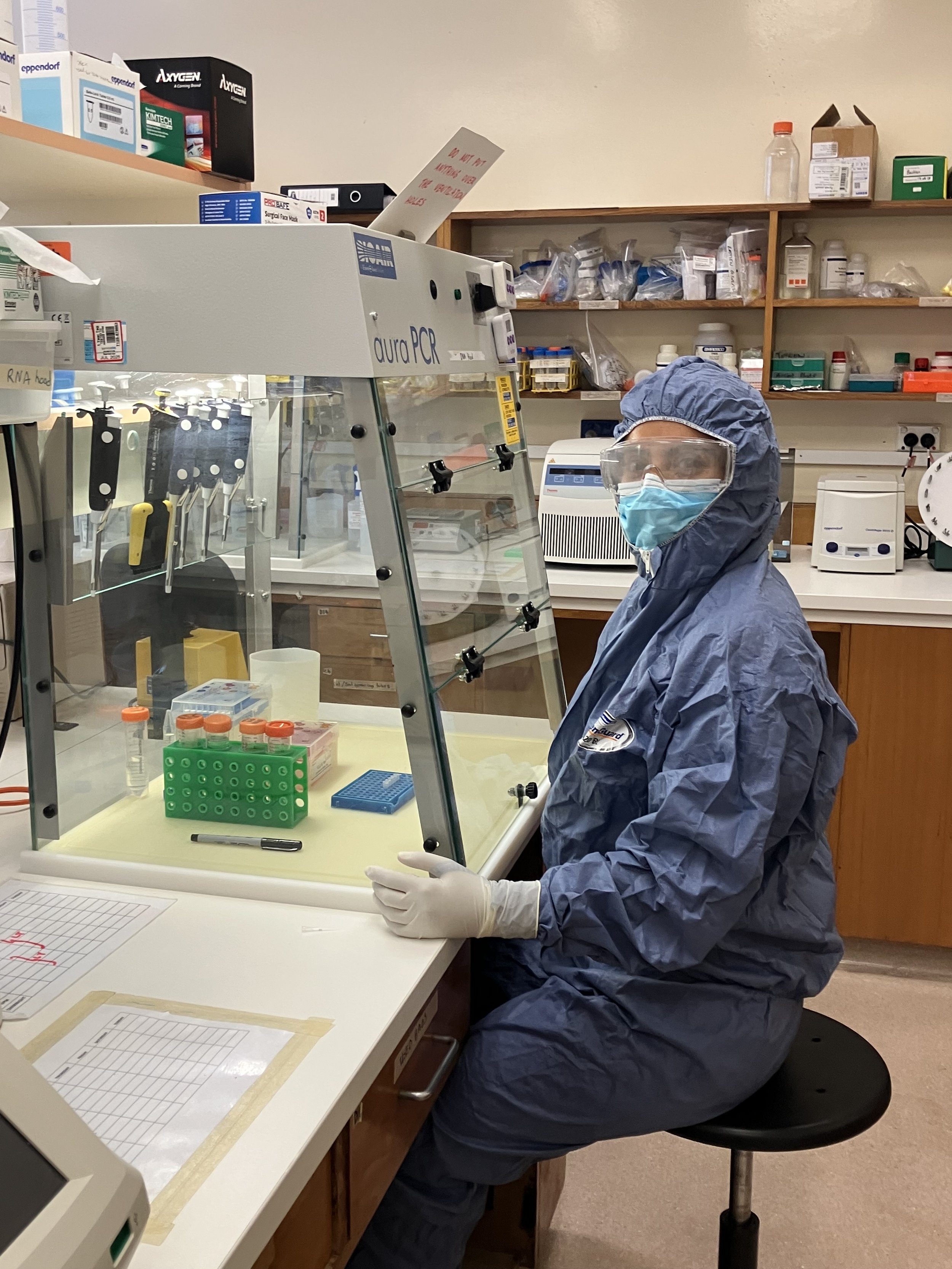
Dr Vilma Pérez uses environmental DNA techniques to understand when and how environments have changed and responded to disturbances
A fascinating new project now has access to the specific computational resources required to build high resolution records of Australia’s changing ecosystems over the past millennium. The research will reconstruct Australian palaeoenvironments and biodiversity using metagenomic analysis of sedimentary ancient DNA collected from mainland Australia and the Torres Strait Islands as part of codesigned projects involving leading Australian researchers and Indigenous partner organisations. Streamlined bioinformatics analysis pipelines will be essential to process the large volume of samples expected to come in from this collaboration.
Sedimentary ancient DNA (sedaDNA) analysis is a transformative tool for studying past biodiversity and its responses to environmental, climatic, and human-induced change. The project aims to build capacity for the growth of sedaDNA research in Australia by automating bioinformatic analyses into a single Nextflow pipeline that can easily produce a robust and reproducible taxonomic profile of both modern and ancient target species found in sediment samples. BioCommons was keen to support the research with access to both ABLeS and our Australian Nextflow Seqera Service.
This project is part of the ARC Centre of Excellence for Indigenous and Environmental Histories and Futures (CIEHF) which seeks to create a lasting impact by integrating Indigenous and Western knowledge frameworks to model environmental, cultural, and historical change in Australia over the past millennium and into the near future.
Dr Vilma Pérez is an environmental microbial ecologist at the Australian Centre for Ancient DNA, The University of Adelaide, who can now access the national computational infrastructure she needs for her research after being onboarded to BioCommons’ ABLeS and Seqera services. Vilma's expertise in using environmental DNA techniques to understand when and how environments have changed and responded to disturbances will be put to good use in CIEHF’s novel genetics research program.
Led by CIEHF Chief Investigator Assoc Prof Ray Tobler from the Evolution of Cultural Diversity Initiative at the Australian National University, the research program will use high-resolution landscape genomic analyses of selected Australian native flora and fauna, as well as ancient DNA recovered from archaeological sediments (sedaDNA).
This work will help reconstruct past Australian ecosystems to understand how biodiversity, from microbes to plants and animals, has changed over time, and how it has responded to environmental shifts, including Indigenous Australian landscape management practices that have helped care for Country for thousands of years.
Gaining access to the right computing infrastructure is one thing, but appropriate computing and data management mechanisms are needed to ensure that Indigenous genomic data resources are ethically managed to the benefit of Indigenous Australians. Mutual partners, Bioplatforms Australia, were able to connect CIEHF with colleagues at the National Computational Infrastructure (NCI) who are working with the National Centre for Indigenous Genomics (NCIG) to host their sensitive sequencing data. Given Indigenous genetics research requires unique ethical approaches, NCIG is leading the way in building a genome resource for the research community under Indigenous Governance and will no doubt have many insights to share.
As part of our ongoing support for CIEHF, Dr Ziad Al Bkhetan, Product Manager - Bioinformatics Platforms at BioCommons, and Dr Kelly Scarlett, Manager - Partnerships and Engagement at Bioplatforms Australia will participate in an upcoming sedaDNA workshop hosted by CIEHF researchers at the University of Adelaide.
This workshop sits within the Genomics research stream which is part of a suite of nine chosen to ensure a holistic, interdisciplinary approach. Find out more about how CIEHF’s research streams are addressing unique environmental, cultural, and historical complexities of Australia through an integrated approach, leveraging both Indigenous knowledge systems and researcher’s fields of expertise.
Knowledge sharing enABLeS computational research across the life sciences
The ABLeS User Group Meetings provide opportunities to come together to share knowledge, offer tips, ask questions or give feedback.
ABLeS (Australian BioCommons Leadership Share) supports groups with their shared data-driven bioinformatics needs, who bring with them a wide range of computational research programs. The research groups benefiting from the program wouldn’t normally have an avenue to share insights and learn from each other’s experiences.
The ABLeS program now includes more than 250 registered participants, representing more than 50 Australian research institutions and a wonderfully diverse array of research projects. The ABLeS User Group Meeting offers opportunities to come together to share knowledge, offer tips, ask questions or give feedback.
Held twice a year, the ABLeS User Group meeting includes presentations from researchers about how they are making use of their allocated computational resources, alongside updates on pertinent developments at both of the Australian peak computational facilities, Pawsey and NCI. This online forum is also a chance to ask questions or provide feedback on how ABLeS can be improved to help different researcher needs.

A poll at the latest User Group meeting suggested an octopus mascot for ABLeS!
At the last meeting, users heard from three different researchers whose projects receive ABLeS resources:
Computational Structural Biology Node, Dr Keiran Rowell (UNSW)
The Effect of a Mediterranean Diet on Blood DNA Methylation Profiles in Pregnant Women, Grace Tavelli (The Kids)
Rare Disease Genetics and Functional Genomics, Assoc Prof Gina Ravenscroft (Perkins Institute)
Given that it was the inaugural ABLeS User Group Meeting, the event opened with a fun activity to find a mascot for the ABLeS service. The most popular option amongst the 39 people attending was a friendly octopus. The ABLeS team is still trying to decipher any hidden message in that choice! Other interesting results from the poll were that the majority of participants joined from NSW and WA, and two thirds of those users were working on non-human species.
The next ABLeS User Group Meeting will take place online on 2 June 2025. Registered users of ABLeS should keep an eye on their inbox for their invitation to attend.
If you aren’t yet registered for ABLeS, you can find out more in this 10 min video explainer or jump straight into the ABLeS documentation.
ABLeS (Australian BioCommons Leadership Share) was established in 2021 to support data-driven bioinformatics. Australian BioCommons partners with Bioplatforms Australia, National Computational Infrastructure (NCI), and Pawsey Supercomputing Research Centre (Pawsey).
Galaxy Australia’s 10 millionth job relied on popular locally-developed tool
The ten millionth job completed on the Galaxy Australia service analysed pathogen samples for known antibiotic resistance genes using the ABRicate tool. You’d be surprised how many time this Australian tool gets used.

At any one time, there is a wide array of research being done using Galaxy Australia. When the ten millionth job was submitted to the service recently, it illuminated the importance of good bioinformatics software. The particular job was one of a bunch that analysed various pathogen samples for known antibiotic resistance genes.
Over the last 7 years, more than 40,000 users representing researchers, students, trainers and trainees have demonstrated the platform's versatility across a wide range of fields. This milestone job investigating antimicrobial resistance employed the ABRicate tool, authored by Australian bioinformatician Torsten Seemann. Further investigation showed that 490,507 jobs run on Galaxy Australia also used ABRicate in their workflows!
The University of Melbourne’s A/Prof Torsten Seemann is the Lead Bioinformatician at the Centre for Pathogen Genomics and the Director of Bioinformatics at Doherty Applied Microbial Genomics. As a world-renowned bioinformatician he has developed cutting edge analysis approaches to enhance the use of genomic data. Torsten has authored many popular software tools for the analysis of bacterial sequence data, particularly in the fields of public health and clinical microbiology. He is also a strong advocate for open-source software and open science.
He created ABRicate for the mass screening of assemblies for antimicrobial resistance and virulence genes. Given a FASTA contig file or a genbank file, ABRicate will perform a mass screening of contigs and identify the presence of antibiotic resistance genes. The user can choose which database to search from a list of available antimicrobial resistance databases.
The name ‘ABRicate’ was chosen as the first 3 letters are a common acronym for ‘Anti-Biotic Resistance.’ The word also has the form of an English verb, which suggests the tool is actually taking action against the problem of antibiotic resistance, and it is uniqueit unique enough to be easily searchable.
The tool is widely available to anyone who needs it, and can be found in many repositories. It is one of over 10,000 tools available in the Galaxy Toolshed. There is a tutorial available on the Galaxy Training Network which supports the use of this tool: Pathogen detection from (direct Nanopore) sequencing data using Galaxy - Foodborne Edition.
Torsten was recently awarded The Chan Zuckerberg Initiative’s Essential Open Source Software for Science grant for the development of another tool, Snippy. This open-source software tool was written to rapidly identify genetic differences between bacterial genome sequences, and work is underway to allow Snippy to support the latest genome sequencing technologies and viral and fungal pathogens too.
In recognition of the ongoing important contributions that Torsten makes, an award was established in his name. The annual ABABCS ‘Torsten Seemann Outstanding Bioinformatics Software Developer Award’ (previously sponsored by the ARDC) recognises an outstanding EMCR bioinformatic software developer from the Australian community with a view to promoting further efforts to develop and share bioinformatics methodologies.
Are your essential tools available on Galaxy Australia? Request an installation by the Galaxy Australia team if there’s a tool you think should be made available for everyone to use.
Nominate your favourite tool’s author for the Torsten Seemann Outstanding Bioinformatics Software Developer Award.
Partners meet to start building the digital infrastructure needed for human genomics research though GUARDIANS
Australian researchers are set to make significant strides in discovering, accessing, and analysing human genomics data. The first in-person meeting of a significant new collaboration brought together partners who are committed to implementing the Australian BioCommons’ GUARDIANS program.

A diverse group came together, including special guest Dr Melissa Konopko from ELIXIR who is standing here with BioCommons’ Prof Bernie Pope.
Australian researchers are set to make significant strides in discovering, accessing, and analysing human genomics data. The first in-person meeting of a significant new collaboration brought together partners who are committed to implementing the Australian BioCommons’ GUARDIANS program.
The meeting in Sydney represented the start of two years of implementation work as part of the GUARDIANS mission to empower Australian researchers to easily and securely discover, access, analyse and use human genomics data across national infrastructure, using the latest tools and resources.
The project brings Australian BioCommons together with Australian Access Federation, Children's Cancer Institute / ZERO, Garvan Institute of Medical Research, National Computational Infrastructure (NCI), QIMR Berghofer Institute of Medical Research, University of Melbourne, and University of Sydney. The project builds on years of foundational work in the Human Genomes Platform Project which also included a funded program and contracted schedules of work with partners.
This first GUARDIANS meeting helped to build a sense of shared purpose as the group established effective ways of working together across their diverse organisations. Explorations into the policies, processes, and technologies that will be required during the project were driven by the open exchange of ideas, and collaborative discussions on solutions to potential challenges.
Scientific Product Manager at ELIXIR, Dr Melissa Konopko, travelled from the UK to share her insights into the Genomic Data Infrastructure (GDI). There were many parallels to learn from this project which is enabling access to genomic and related phenotypic and clinical data across Europe through establishing a federated, sustainable and secure infrastructure to access the data.
Contact us if you’d like to learn more.
Productive connections in the global Nextflow community forged by co-working
A group of Nextflow enthusiasts will come together in Sydney to take part in the global nf-core hackathon in March. By hosting the first Australian satellite site, we hope to unlock new opportunities for both national and international collaboration.

A group of Nextflow enthusiasts will come together in Sydney to take part in the global nf-core hackathon in March. By hosting the first Australian satellite site, we hope to unlock new opportunities for both national and international collaboration.
The global nf-core community curates a set of open‑source analysis pipelines built using Nextflow and they connect regularly through in person and online events. For the first time, the international hackathon’s network of live sites is extending to Australia, with the Australian outpost of the 2025 nf-core hackathon facilitating participation during our waking hours across 24-26 Mar 2025. The group will work on a variety of projects including development of training materials and nf-core workflows alongside our five local Nextflow Ambassadors and their international colleagues.
BioCommons’ Product Manager, Bioinformatics Platforms, Dr Ziad Al Bkhetan is a Nextflow Ambassador who has experienced the value of forging strong relationships in the global Nexflow community. In his work leading the Australian Nextflow Seqera Service, Ziad identified that Proteinfold, an existing nf-core pipeline for Protein 3D Structure prediction, had great potential for Australian researchers.
Ziad identified several ways to improve Proteinfold and connected with the original developers at the Centre for Genomic Regulation (CRG) in Spain, to reconfigure the workflow, add new features, and contribute the updates back to nf-core. Ziad’s demonstration of the new tool at the last Nextflow Summit created excitement in the Nextflow community. Seqera, the team behind Nexflow, was delighted that their community-driven approach is resulting in new tools being developed by people at the research interface. CRG was pleased to see that their contribution to the community facilitated a new working relationship between their Spanish biomedical research institute and Australian BioCommons. Ziad and the team from CRG will continue to work on their workflow at the nf-core hackathon, and welcome contributions from any other community members.
We’re looking forward to connecting with the Seqera team and international peers at the nf-core hackathon to develop workflows and training materials asynchronously. There is a growing list of projects being proposed and we can expect that the range will expand as teams around the world get to work.
Finding the right collaborator can fast track a project like nothing else, and specialist fields of research almost guarantee your perfect match will be on the other side of the world. We’ve already seen how strategic events can bring global developer communities together to forge valuable new relationships in the Nextflow community, and hope to catalyse more of these opportunities.
Let us know if you are interested in joining the nf-core hackathon: Australian Outpost.
Addressing DNA sequencing data submission challenges at global scale: your invitation to learn from the experts
A range of special events for Australian researchers will focus on streamlining the data submission processes for various data types, addressing common challenges, and providing best-practice guidance on interacting with the European Nucleotide Archive (ENA).

Data submission to international repositories is an essential task for researchers, but it can often come with challenges. A range of special events for Australian researchers will focus on streamlining the data submission processes for various data types, addressing common challenges, and providing best-practice guidance on interacting with the European Nucleotide Archive (ENA).
BioCommons is partnering with specialists from the ENA and the European Molecular Biology Laboratory’s European Bioinformatics Institute (EMBL-EBI) to deliver a series of hands-on workshops and online community discussions to help Australian researchers share their valuable data. The ENA is committed to maximising the impact of the ENA platform, sequencing technology and data, and will travel to Australia to support local researchers' data submission and discuss our particular needs.
The two-week program in late March and early April will feature seven targeted workshops covering submission and retrieval workflows for specific data types (raw reads, assembled and annotated genomes, metagenome assembled genomes (MAGs) and environmental DNA (eDNA)). Three interactive online community discussions around the same themes round out the program and offer the opportunity for Australian researchers to share their experiences, challenges and potential solutions directly with international specialists from the ENA.
ENA is a globally recognised open platform for the management, sharing, integration, archiving and dissemination of nucleotide sequence data. This comprehensive resource preserves the world’s public-domain output of sequence data and is an essential tool for many researchers, but sometimes people can struggle with using it. Given that submission of omics data and associated contextual metadata to global data repositories is considered best practice and is mandated by science publishers, we want to enable researchers to facilitate the long-term preservation, findability and reusability of their data.
This is a unique opportunity to gain invaluable insights and practical skills from leading experts in omics data management and submission. Whether you're a seasoned researcher or just starting out, these workshops and discussions will empower you to confidently navigate the complexities of data sharing.
'Roundtable' Community Discussions: Challenges and solutions
01 - 03 Apr, 10:00-12:00 AEDT
Join our online 'Roundtable' Community Discussions with members of the ENA team.
Each session will focus on a different theme: Genomics - genome annotations and assemblies, and pangenomes; MAGs - submitting MAGs at scale, and how to submit MAG data when there are gaps in the NCBI species taxonomy; and eDNA - recent changes enabling eDNA sequences to be more findable through submission to ENA. Register here for roundtables.
Hands-on Training workshops: Data submission and retrieval
25 Mar - 03 Apr, 13:00-16:00 AEDT
Learn directly from the ENA team in a range of practical online training workshops to explain genome assembly and annotation, MAG and eDNA data submission and retrieval.
Our community consultations teased out some of the challenges faced by Australian-based researchers in the data submission process, and BioCommons published a set of recommendations to address them. One ambition of a range of ongoing activities around interfacing with international omics data repositories is to facilitate improvements by connecting the right people.
The European Nucleotide Archive (ENA) is a Global Core Biodata Resource, an ELIXIR Core Data Resource and is hosted by EMBL-EBI. It is one of the three nodes of the International Nucleotide Sequence Database Collaboration (INSDC).
INSDC is actively seeking additional members to enhance Global Participation.
Pawsey enables more flexible and scalable DNA analysis
Researchers have developed a novel solution to process nanopore sequencing data on any mainstream GPU hardware, expanding computational options for the global bioinformatics community. Slorado is the first open-source software/library solution for nanopore sequencing basecalling on AMD Graphic Processing Units (GPUs). It was developed using Australia’s most powerful supercomputer at the Pawsey Supercomputing Research Centre with the support of the Australian BioCommons Leadership Share (ABLeS).
This story about researchers accessing high performance computing via the Australian BioCommons Leadership Share (ABLeS) was first published by the Pawsey Supercomputing Research Centre.

Dr Hasindu Gamaarachchi and Bonson Wong, the researchers behind Slorado, the new open source software for nanopore sequencing basecalling on AMD GPUs. Credits UNSW Sydney
Researchers from UNSW Sydney and the Garvan Institute of Medical Research have developed Slorado, the first open-source software/library solution for nanopore sequencing basecalling on AMD Graphic Processing Units (GPUs). Using Setonix, Australia’s most powerful supercomputer at the Pawsey Supercomputing Research Centre, this development enables researchers worldwide to process nanopore sequencing data on any mainstream GPU hardware for the first time, expanding computational options for the global bioinformatics community.
Oxford Nanopore Technologies (ONT) sequencers generate time-series raw signals that need to be converted into DNA bases through a process called basecalling. While ONT’s Dorado software supports NVIDIA GPUs for this process, AMD GPUs are currently not supported.
Led by Dr Hasindu Gamaarachchi and PhD candidate Bonson Wong, the team has created a streamlined version of the industry-standard Dorado basecaller that removes previous hardware limitations while maintaining and in some cases increasing performance. This innovation allows researchers to utilise AMD GPUs, including those in Pawsey’s Setonix, Australia’s fastest and most energy-efficient research supercomputer, reducing processing times and wait periods for critical genomic research.
Pawsey CEO Mark Stickells underscored the impact of this development:
“Dr Gamaarachchi’s work highlights our mission to accelerate scientific discovery. Fast, efficient bioinformatics is key to addressing challenges in medicine and biotechnology, from genomic analysis to drug discovery and personalised medicine. By enabling nanopore sequencing on Setonix’s AMD GPUs, we are breaking down computational barriers and empowering researchers with world-class tools,” Mark said.
“This collaboration demonstrates how state-of-the-art infrastructure can transform research workflows and broaden access to advanced computational tools.” He continued.
Dr Gamaarachchi and Bonson Wong shared their vision for Slorado:
”Our goal was to expand computational options for the bioinformatics community. By enabling basecalling on AMD GPUs and making the software fully open-source, we are empowering researchers to process their data more efficiently using both AMD and NVIDIA hardware.”
Slorado supports up to eight GPUs simultaneously on the same node, delivering unprecedented processing capabilities when combined with systems like Setonix. Researchers can now achieve faster results without enduring lengthy queue times, accelerating the pace of critical genomic discoveries.
The team access to Setonix has been supported via the Australian BioCommons Leadership Share (ABLeS).
To know more about Slorado, register for an online event on 18 Mar 2025:
Accelerating Nanopore Analysis: Introducing the new Open Source Slorado.