News
Subscribe to the Australian BioCommons monthly newsletter or read previous editions
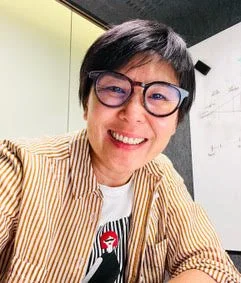
Meet the Team: Mok, UX Designer
Our team members bring deep expertise and broad experience. Hear how a UX Designer contributes to the BioCommons mission. Mok is our friendly translator who sits between complex systems and real humans, reshaping complicated processes into smooth, logical journeys.
Describe your role at BioCommons
I’m a user experience (UX) Designer at BioCommons, which means that I help improve infrastructure and scientific research by being the friendly translator between complex systems and real humans. This type of role is new in the life sciences field, making it a lot of fun, as I sit at the intersection of science, data, and human-centred design, helping researchers, bioinformaticians, and software engineers make sense of the inherently complex biological tools and platforms they use everyday. The goal is to make it look easy - even when it’s not!
It’s challenging work, because the problems are big and complex. You’re designing for expert users, emerging technologies, and systems that genuinely matter.
There’s a lot to learn, a lot to ask, and plenty of moments where curiosity and collaboration are essential. This makes the role deeply rewarding, as your work doesn’t just improve usability; it helps accelerate research, supports discovery, and amplifies the impact of national life-science infrastructure.
How can UX Designers improve infrastructure and/or scientific research?
Think of scientific infrastructure as a powerful machine: data platforms, tools, pipelines, and services that can do amazing things. A UX Designer ensures that people can actually use that power without needing a PhD in ‘figuring stuff out’.
By taking complicated processes and reshaping them into smooth, logical journeys, we turn confusion into clarity. This saves researchers time and frustration - when tools are intuitive, scientists spend less time wrestling with interfaces and more time doing what they love: discovering, analysing, and innovating.
Good UX also makes infrastructure more accessible. It opens the door for students and early-career researchers to use advanced systems confidently, rather than those tools being limited to the experts that already know the ropes. By asking the right questions early and understanding user needs upfront, we help teams build the right thing the first time. This reduces rework and ensures that research workflows flow smoothly, helping insights travel from idea to impact more quickly.
What is the real-world impact of human-centred design at BioCommons?
At BioCommons, my impact is all about making powerful research infrastructure feel simple, friendly, and usable. I focus on turning complex scientific tools into clear experiences, helping researchers spend less time navigating systems and more time doing great science.
By listening to users and smoothing out workflows, I help ensure that BioCommons tools are not just functional, but adopted and used to their full potential. In short: I make hard things easier, science faster, and national infrastructure more human.
What makes solving scientific problems so rewarding?
This is not your average UX gig, and that’s exactly the point. I get to work closely with scientists, engineers, product leads, and stakeholders who are passionate about what they do and who will happily stretch my thinking.
It is incredibly rewarding to work in a space where UX isn’t just ‘nice to have’, but genuinely transformative. There is a unique joy in those moments where a complex process suddenly becomes clear and usable.
In short: it’s a role for UX designers who like their work meaningful, their challenges meaty, and their wins shared with science itself!
Meet the team: Kylie Davies, Senior Business Analyst
Our team members bring deep expertise and broad experience. Hear how a Business Analyst contributes to the BioCommons mission from Kylie Davies.
Describe your role at Australian BioCommons
My role with Australian BioCommons has been to work as a business analyst for the GUARDIANS project - a multi-organisational project aimed at uplifting Australia's Genomic research capabilities and opportunities through the creation of national infrastructure that brings down barriers to the secure sharing of human genomic data. The better and quicker this access can be, the better and broader the opportunities to solve complex and challenging human diseases.

How can Business Analysts improve infrastructure and/or scientific research?
The role of the Business Analyst (BA) is always multifaceted. At the start of a project the BA focuses heavily on unpacking the project work packages with the input of subject matter experts, and translating these into detailed use cases and requirements. Even in Agile units this work is critical. The BA sits between the technical development team and the Project Management (PM) team; and between the future users and the project team (both technical and PM).
“Your role is to get into the weeds enough to unpick the key deliverables and major challenges, while managing the expectations of stakeholders to help the team achieve delivery of a technical product that is fit for purpose and delivers the key requirements.”
A good BA will have experience and some understanding of technical matters, User Experience considerations and project scope. They should be a good listener and good at eliciting information in a relaxed way. We are just one part of the team, but we make a vital contribution in ensuring the planned infrastructure is delivered in such a way that it meets the real needs of users, with all parties being clear about the key deliverables from a business value perspective. Even research infrastructure has a measured business value. If this is delivered, not only does it serve scientific researchers better, but it means the business case for future improvements (and further project funding) easier to make.
Tell us about the impact of your role
I think for some of the project teams across the GUARDIANS project and its predecessor project, on which I also worked, they had not worked through requirements with a Business Analyst before. They found that the process clarified the details of their plans and freed them up to get cracking on development work without circular discussions and going down too many rabbit holes mid-development.
In the research world, it is necessary to allow for enquiry and discussion. It's different from commercial environments in that we need to allow flexibility for exploration. I needed to learn that when I first worked with researchers starting in 2021. There is a necessary tension between maintaining freedom to explore and avoiding paralysis by analysis.
I think probably one impact I had as the BA was to convene forums and exercises for that exploration to really flourish, but then encourage decisions to be made at a certain point through the documentation of requirements. The feedback I have received indicated that the project teams felt that they were clearer about their goals and felt heard, and yet unified, in their development plans as a result of the work we did together. Then as the products were rolled out, they could demonstrate to wider audiences not only what they had developed, but how each element served use cases.
I should add I have learned a lot too in my role from other BAs. There are a couple of other BAs working on GUARDIANS and it's been a pleasure and learning experience particularly to see them work with stakeholders. We also have a highly experienced BA inhouse at BioCommons in the form of Farah Zaib Khan and I am in awe of Farah's work. We have caught up a few times to share techniques.
What’s next?
I am retiring soon. I am happy to be retiring although it's come a little earlier than I had originally planned, due to my own cancer diagnosis mid 2023. I continue to be well but it is a progressive form of disease so the medical interventions are becoming more frequent, but still not too terrible.
I am living proof of the benefits of medical research. The prognosis for the type of cancer I have was extremely poor a decade ago, but I have been able to access three new cancer drugs delivered to us very recently by clinical research. The drug I am on now was TGA approved in 2025! This has delivered tangible and hugely valuable benefits for me. I have been able to work and enjoy a good quality of life. I undertook a wonderful adventure holiday in 2025. Thank you to Australia's research community for this.
2026 will see me nesting more at home. I have a large garden and grow some produce and I am aiming to ramp that up as soon as I finish work. I have adult children who are some of my favourite humans and plan to catch up with them and friends a bit more. And fish and boat with my husband who is retiring at the same time.
I will continue to be involved in two voluntary consumer representative groups for cancer treatment centres, and I hope to follow the progress of GUARDIANS and BioCommons as a remote observer.