
News
Subscribe to the Australian BioCommons monthly newsletter or read previous editions
Boosting genomic medicine in Sri Lanka
A workshop in Sri Lanka taught medical doctors, research lab workers and university students to use Galaxy Australia for genomic medicine.

A group of Sri Lankan medical doctors, research lab workers and university students have just completed a hands-on bioinformatics training program using Galaxy to learn about genomics. Galaxy Australia team member, Dr Nuwan Goonasekera, joined an international panel of experts to deliver the workshop Bioinformatics for Genomic Medicine.
The US Embassy in Sri Lanka and Genelabs Medical offered the three week course to empower Sri Lankan genomics researchers to independently process and analyse DNA and RNA sequencing data. Participants gained the skills needed to identify clinically actionable mutations, helping to guide treatment plans based on patient data.
Dr Shurjo Sen from the NIH National Human Genome Research Institute (NHGRI) Office of Genomics Data Science requested Nuwan teach the 28 participants to use Galaxy in collaboration with the University of Colombo. The Galaxy Australia service underpinned the training while trainees were learning how to use Galaxy for sequence analysis and Nuwan made good use of Galaxy Australia’s Training Infrastructure as a Service (TIaaS). They also accessed the NHGRI Genomic Data Science Analysis, Visualization, and Informatics Lab-space (AnVIL) to learn cloud computing and variant interpretation techniques. Use of this cloud-based genomic data sharing and analysis platform, along with Galaxy, will empower these Sri Lankan genomics researchers to access and analyse large genomic datasets in a collective and collaborative way.
Researchers come together to tackle the bioinformatics of fungal genomics
A diverse group representing commercial enterprise, academia, government research and citizen scientists gathered at ANU for a hands-on fungi bioinformatics workshop. The skills uplift was designed to support Bioplatforms Australia’s Functional Fungi and Plant Pathogen Omics National Initiatives.

Bioplatforms Australia brought together members of the Functional Fungi and Plant Pathogen Omics National Initiatives for a hands-on fungi bioinformatics workshop. Recognising that high throughput sequencing is the new normal for fungi research, hosts Prof Benjamin Schwessinger (Australian National University) and Dr Alistair McTaggart (Psymbiotika Lab) guided 38 researchers through theory sessions, hands-on practice, and real examples of applying bioinformatics to fungal research. Attendees were of diverse backgrounds in commercial enterprise, academia, government research and citizen science.
Each theory session was followed by a hands-on demonstration using Galaxy Australia. For example, Dr Mareike Möller (ANU) led a theory session on fungal genome assembly covering key concepts such as why long reads are essential for assembling complete genomes, and why genome assembly is like tackling the world’s hardest jigsaw puzzle. This was followed by Dr Anna Syme’s demonstration of genome assembly on Galaxy Australia. Anna wrote six dedicated workflows for fungi, which are now publicly available for any Australian to reuse or adapt on Galaxy Australia. To access them, head to Public Workflows and filter by tag ‘fungi’. If you’re just getting started with workflows, watch Anna’s Top Tips for using Galaxy workflows.
Benjamin and Alistair ensured the workshop was directly relevant to real-world fungal and plant pathogen research. All demonstrations used fungi data shared by Alistair, plus Dr Tara Garrad and Dr Kelly Hill from the South Australian Research and Development Institute, which remains available in the Bioplatforms Australia Data Portal.
Workshop participants felt that the mix of hands-on and theory sessions was ideal; demystifying the technology and bringing clarity to the broad array of options available in Galaxy Australia. Workshop materials and metadata are available in the Australian BioCommons Training Materials Zenodo repository.
Helping the bioinformatics community harness the computing resources they need
A recent workshop explored strategies for the adoption, usage, and optimisation of GPUs and addressed researchers’ challenges to accessing high performance computing.

Exploring GPUs with Sarah at the ABACBS Conference workshop
The challenges researchers face when accessing high performance computing was addressed at a recent workshop led by a national group of experts. More than 40 researchers and bioinformaticians explored strategies for the adoption, usage, and optimisation of Graphics Processing Units (GPUs) at ABACBS 2024 in December.
The workshop was co-ordinated by Dr Andrew Lonsdale (Peter MacCallum Cancer Centre), Dr Sarah Beecroft (Pawsey Supercomputing Research Centre) and Dr Johan Gustafsson (Australian BioCommons). It featured a wide range of speakers covering practical insights on resource availability, portable code that runs efficiently on multiple GPU platforms (NVIDIA, AMD, and Intel), and real-world use cases.
The availability of GPUs in the Australia context was introduced by Andrew Lonsdale (Peter Mac), and Georgie Samaha (BioCommons) offered practical guidance on accessing GPUs via national resources and access schemes. Sarah Beecroft (Pawsey) provided a concise introduction to high performance computing principles including GPU access, to ensure everyone shared similar foundational knowledge. George Bouras (University of Adelaide) then demonstrated how to integrate machine learning frameworks like PyTorch with the Slurm scheduler, while Edward Yang (WEHI) presented best practices for writing interoperable, maintainable GPU code.
Highlighting real-world applications, Keiran Rowell, Nathan Glades, and Josh Caley (UNSW Structural Biology Facility) showcased how GPUs are empowering researchers to handle large, complex structural biology datasets, and Wytamma Wirth (University of Melbourne) illustrated the power of online GPU resources to accelerate in Bayesian phylogenetics analyses.
Feedback showed that attendees appreciated the variety of speakers and the balance of technical depth with practical applicability. They particularly highlighted the workshop’s interactive approach, which included live polling and ample Q&A sessions.
Half of the attendees reported they were already using GPUs, and the other half planned to adopt them soon. Two-thirds were keen to integrate existing GPU-enabled bioinformatics tools, while one-third aimed to develop new GPU-accelerated algorithms, underscoring the community’s readiness to embrace GPUs both as a means of immediately accelerating current workflows, and as a basis for innovative tool development.
This workshop aimed to support researchers with the knowledge, skills, and resources they need to unlock the full potential of GPU computing, and participants reported that they were keen to go on to investigate GPU applications beyond AI/ML, gain deeper insights into GPU architectures, and participate in more hands-on training sessions.
Attending the ABACBS Conference is a great way to connect and strengthen the GPU-enabled bioinformatics community in Australia, and Australian BioCommons sponsors and attends the conference each year to hear from researchers and bioinformaticians and to share responses to their research infrastructure priorities. Stay tuned for more information about ABACBS 2025 in Adelaide!
Australian researchers tells us about their bioinformatics training needs
Our 2023 bioinformatics training needs survey revealed the topics that the life science community want to learn about and that a blend of live and self-paced training is preferred.

Word cloud from responses to the prompt “I need to learn…”
Australian BioCommons and the National Bioinformatics Training Cooperative regularly surveys the life science community to find out what they need to learn, how they want to learn and if this is changing over time. The results of our 2023 survey are now available on Zenodo.
The survey shows that people want live training supported by self-paced materials. This was an exciting outcome for those of us in the training world as it’s a fantastic way to cement new skills and promote ongoing learning!
As for the topics they need to learn, there is continued need for training on analysis of omics data, workflow management and a variety of tools, platforms and computational methods. Emerging topics from our 2021 survey (e.g. single cell RNAseq and Machine learning) remained popular in 2023. Spatial omics was revealed as an emerging training need reflecting the growing use of this method. The responses show that for trainees the focus is on what they need to achieve rather than how they need to achieve it highlighting the important role that subject matter experts and trainers have to play in shaping best practices. Australian BioCommons and our National Bioinformatics Training Cooperative are using these results to help us make sure that the training we offer is relevant.
We share the results of the survey in the spirit of openness and in the hope that it will spark conversations about the bioinformatics training needs of the life science community locally, nationally and internationally.
Keen to dig into the results? Read the report and download the data from Zenodo.
Success of BioCommons-ELIXIR partnership showcased on the international stage
ICRI 2024 explored global trends, challenges, and opportunities in research infrastructure, including an official side event: Euro-Australian research infrastructure collaboration in the molecular life sciences.
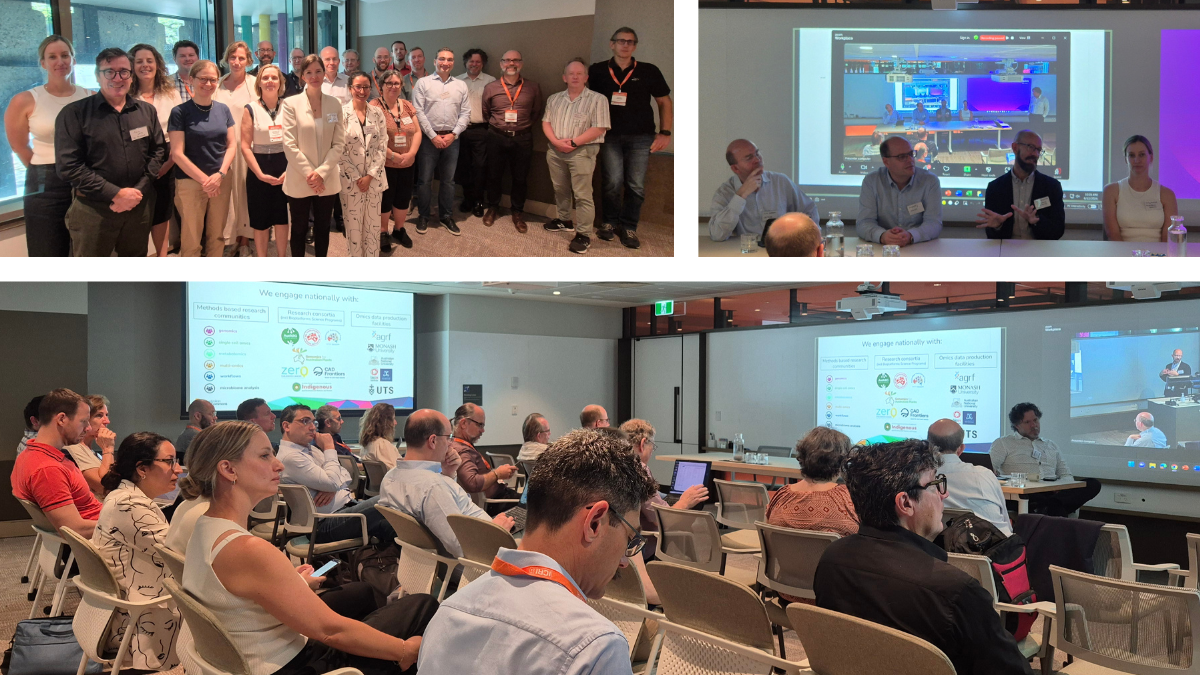
A showcase of outcomes that are being realised through international collaboration between life science data infrastructures were recently discussed by the global research infrastructure community at an international gathering.
The 2024 International Conference on Research Infrastructures (ICRI 2024) explored global trends, challenges, and opportunities in research infrastructure. The December meeting was held in Brisbane - the first time ICRI has been hosted in the Asia Pacific - and attracted policymakers, research institution leaders, facility operators, users and researchers. Around 420 people from 50 nations travelled to Australia, including delegates from 11 Southeast Asian and Pacific nations, for this year’s event. Another 500 people joined online from 39 nations.
Significantly, the 2024 event was the first ICRI to focus on Indigenous knowledge and engagement. Organising the meeting was a joint effort between Australia’s national science agency (CSIRO), the European Commission, and the Australian Department of Education.
With a Euro-Australian bioinformatics infrastructure collaboration agreement now into its fifth year, representatives from BioCommons and ELIXIR hosted an official side event, Euro-Australian research infrastructure collaboration in the molecular life sciences. Partners described fruitful outcomes for the global community, and key examples from BioCommons’ perspective were highlighted, including our enablement of:
A multi-week coworking session for Galaxy Australia and Galaxy Europe staff in Brisbane in 2023
Shared product ownership of WorkflowHub between Australian and European colleagues
Launch of Australia’s DReSA and incorporation of its codebase into ELIXIR’s TeSS
The Australian Outpost of ELIXIR’s BioHackathon Europe in 2022, 23, and 24
Codevelopment of genome assembly and annotation pipelines for biodiversity efforts
Connection building to target efficient data publishing and re-use in a global context
Presenters at this event included Kelly Scarlett from Bioplatforms Australia who set the context within the National Collaborative Research Infrastructure Strategy (NCRIS), Ondřej Hradil representing the European Strategy Forum on Research Infrastructures (ESFRI), Jeff Christiansen and Nigel Ward representing Australian BioCommons, Tim Hubbard representing ELIXIR, Fotis Psomopoulos representing CERTH and ELIXIR Greece, and Gerry Reilly representing BioFAIR UK.
To capture the international goodwill generated and the progress made during the ICRI conference, organisers published The Brisbane Statement. It encourages all research infrastructure (RI) stakeholders to actively consider the role of RIs in addressing global challenges, and how strengthening international RI collaborations can help solve them.
Australian BioCommons is supported by Bioplatforms Australia, which is enabled by NCRIS.
An international approach to harnessing AI opportunities in the life sciences
We recently hosted Prof Ewan Birney, Deputy Director General of the European Molecular Biology Laboratory (EMBL) and Director of EMBL’s European Bioinformatics Institute (EMBL-EBI) in Melbourne to share his views in a workshop: Exploring opportunities in Life Sciences AI.

From left to right: Prof Ewan Birney, Andrew Gilbert, Dr Jeff Christiansen, Prof Andrew Lonie
Many of us are exploring the opportunities that AI brings to life sciences. Australian BioCommons and Bioplatforms Australia recently hosted Prof Ewan Birney, Deputy Director General of the European Molecular Biology Laboratory (EMBL) and Director of EMBL’s European Bioinformatics Institute (EMBL-EBI) at the University of Melbourne to share his views in a workshop: Exploring opportunities in Life Sciences AI.
The workshop focused on existing activities in Australia and global AI developments, with a facilitated discussion on how to build effective collaborations between infrastructures and researchers in the AI-life sciences space, and what opportunities there are for Australia to collaborate more closely with the EU across life sciences infrastructure, data, informatics, training and research programs.
Prof Birney’s visit included a keynote address at the iconic Shine Dome in Canberra. Co-hosted by EMBL Australia and Bioplatforms Australia, the event included talks from international and Australian experts, and drew scientists and senior leadership from a range of organisations, including CSIRO, Monash University, UNSW, the Australian National University, the University of Canberra, the Australian Government Department of Education, NCRIS projects, Snow Medical and Research Australia, as well as postdoctoral researchers and students. Read more about Prof Birney’s presentation in EMBL Australia’s news item.
As well as helping BioCommons to coalesce its approach to facilitating AI application in life sciences, the visit has strengthened the connection between BioCommons and EMBL and has led to ongoing discussions about future cooperation. Meeting in person was an excellent opportunity to clarify our intersecting needs, and establish a foundation to work together more closely into the future.
Australian Outpost of BioHackathon Europe connects researchers to help shape global bioinformatics advances
The latest edition of the Australian Outpost of ELIXIR’s BioHackathon Europe brought together a group of researchers in Brisbane to help shape global bioinformatics advancements while networking with other life scientists, bioinformaticians and developers both at home and abroad.

A diverse collection of Australian researchers gathered in Brisbane for the latest edition of ELIXIR’s BioHackathon Europe. Thanks to the ongoing collaboration between Australian BioComons and ELIXIR, Australian life scientists had a powerful opportunity to shape global bioinformatics advancements, while networking with other life scientists both at home and abroad.
From 4 - 8 Nov, 18 keen Aussies worked from 12 - 9:30 pm each day to allow overlap with the European participants. This year our group worked across three projects:
One team developed a prototype data model converter that makes it easy to switch between data models for a given biomedical cohort. The team built mappings between common data formats OMOP and FHIR and central ‘meta cohort’ format, plus made a front end interface that enables data upload, selection of the data model, selection of the data format, and download of the converted dataset. This team was highly collaborative, with members from the BioCommons Human Genome Informatics team, software and bioinformatics engineers from Children’s Cancer Institute (CCI), bioinformaticians and data scientists from the Sydney Informatics Hub, and a University of Melbourne Masters of Genomics and Health student.
A particularly diverse team with representatives from BioCommons, Melbourne Bioinformatics, Curtin University, University of Sydney (Threatened Species Initiative), University of Tasmania, Symbio Labs, and QUT contributed to the FAIRtracks metadata schema. Their wide range of experience across conservation, agriculture and biodiversity was a new angle for a project that had previously focused on human data. The Aussies built many new connections and had a strong influence on the extension of the FAIRtracks schema into the life sciences.
Another team worked on was a key component of a larger European effort to ensure the global Galaxy project is sustainable and resources remain clearly accessible. Building the ‘Galaxy Codex’ led to major improvements in the findability of Galaxy resources such as tools, workflows and training material across microbiology, single cell omics, and proteomics.
Outside of the project work, the local team spent plenty of time getting to know each other and building their professional relationships, plus ate plenty of Spanish food to feel more connected to the Barcelona event! Dr Tim White, Data Science Software Engineer at the Sydney Informatics Hub, found collaborating in real time invaluable:
Typically in software development we are presented with the final product and don’t get to see the drafting process. It was fantastic to collaborate with the CCI software engineers to develop the code together and share what we consider at each stage of development.
Meanwhile, Dr Christian Fares, Senior Software Engineer at CCI, said their team found significant benefit from working outside of their usual area:
Our day to day roles wouldn’t normally encompass data model conversion, so we gained fantastic experience in a new area. We’ve been intending to learn more about the FHIR data standard, so attending the Aussie Outpost was a great opportunity, and we’ll be sharing our learnings with the rest of the CCI team soon.
We'll be bringing together another team for the next BioHackathon Europe in Nov 2025 - keep your eyes peeled for our call for applications mid next year! In the meantime, read ELIXIR’s summary of BioHackathon Europe 2024.
Supercomputing access powers development of a new multi-omics resource
Australian researchers from the International Cannabis Genomics Research Consortium (ICGRC) have developed a web portal that is freely available for the global cannabis research community to use.

A new bioinformatics platform to support multi omics has been released by Australian members of the International Cannabis Genomics Research Consortium (ICGRC). The web accessible platform is designed for data sharing, hosting and analysis and is freely available for the global cannabis research community to use.
Researchers from Southern Cross University, Locedie Manseuto and Dr Ramil Mauleon wanted to build an authoritative, open-science focused, web portal that would support multi-omics research on Cannabis sativa. Leveraging their ongoing connection to Australian BioCommons via the multi-omics community, Loc and Mau sought support from the Australian BioCommons Leadership Share (ABLeS) to help build a key feature of the web portal: CannSeek. The CannSeek database contains approximately 100 million single-nucleotide polymorphisms (SNPs, pronounced ‘snips’). As part of his PhD thesis, Loc produced CannSeek with support from the Australian BioCommons Leadership Share (ABLeS):
We needed access to a large supercomputing allocation to allow us to analyse the entire collection of multi-sample Cannabis sativa next-generation sequencing data available in NCBI (over 2,500 samples in Dec 2022). Our allocation on NCI’s Gadi supercomputer via ABLeS was instrumental in analysing such a large quantity of sequence data.
Loc continued to work on Gadi to optimise a variant calling pipeline that combines both GATK and Parabricks software.
We deployed the optimised variant calling pipeline to compare three reference genomes with the 2,500 next-generation sequencing samples. We identified 90-100 million SNPs that form the CannSeek database. Compare this to the roughly 30 million SNPs from 3,000 rice samples and you can see why we needed the supercomputing resources!
Mau notes that the computational challenges didn’t end there:
The Gadi supercomputer was equally instrumental in solving our next challenge of finding a small (~1,500) subset of SNPs from the CannSeek database that would allow fingerprinting and differentiation of samples from the Cannabis sativa population. The small subset was critical to prepare, as it’s far too expensive to use ~30M SNPs for routine sample fingerprinting!
The ICGRC web portal contains several other omics tools like a JBrowse genome browser, a gene function database search, and an expression heatmap.
Learn more about the development of the ICGRC portal and the CannSeek database:
Learn more about ABLeS on our website, or watch a 10 minute overview of the service.
First batch of clinical data arrives in new data platform
The first batch of clinical data for the Australian Cardiovascular disease Data Commons (ACDC) has arrived and is now loaded onto the project’s secure staging environment.

A large collaborative effort striving to take the next leap toward protecting Australians at risk of coronary artery disease recently made significant progress. The first batch of clinical data for the Australian Cardiovascular disease Data Commons (ACDC) has arrived and is now loaded onto the project’s secure staging environment.
The dataset is from the Baker Heart and Diabetes Institute’s Australian Diabetes, Obesity and Lifestyle Study (AusDiab), a national population-based survey of 11,247 adults which is examining the natural history of diabetes, pre-diabetes, heart disease and kidney disease among Australian participants. AusDiab began in 1999 and is still following up with participants - making it Australia's largest longitudinal study in the field.
The ACDC project has drawn together an amazing array of clinicians, researchers, digital infrastructure experts, and consumer representatives. Work on the platform is ongoing, with data modelling, testing and validation continuing with partners from Baker Heart and Diabetes Institute, ACvA, The University of Sydney, 23Strands, CSL Limited and 18 cohort custodians. In the years to come, the platform will improve the capacity for Australian medical researchers to undertake discovery and translational research, specifically cardiovascular risk assessment and treatment.
Australian BioCommons is leading the implementation of the digital infrastructure underpinning ACDC, using the Gen3 data commons platform. Ultimately, the ACDC will become a critical data infrastructure housing pooled data from approximately 400,000 individuals representing up to 18 clinical cohorts from across Australia.
Learn more about how we are building the ACDC.
Australian BioCommons activities and services on show at eResearch Australasia 2024
eResearch Australasia will feature BioCommons staff and collaborators presenting a range of our activities and engage with delegates interested in information-centric research capabilities.

The 2024 eResearch Australasia Conference will take place in Melbourne from 28 October – 1 November. eResearch offers delegates interested in information-centric research capabilities the chance to engage, connect, and share their ideas. Sessions will cover how information and communication technologies help researchers to collaborate, collect, manage, share, process, analyse, store, find, understand and re-use information.
BioCommons staff and our collaborators will present a diverse range of activities will be on show at the conference. Please join us at the sessions below!
Tue Oct 29
16:05 - Presentation: Taking stock of biological data resources (Keeva Connolly)
16:25 - Presentation: ARGA’s UI: giving genomic data repositories a glow-up (Caitlin Ramsay and Mok)
16:25 - BoF session: Revealing the invisible: the challenge of measuring and communicating the impact of research infrastructures (Christina Hall)
Wed Oct 30
10:45 - Presentation: Through the looking glass: visualising taxonomic histories on the ARGA user interface for richer provenance (Kathryn Hall)
11:25 - BoF session: Learnings from a landscape analysis of AI/ML infrastructure opportunities and challenges (Andrew Gilbert)
11:45 - Lightning Talk: Galaxy Australia – making use of national and commercial GPGPU resources (Keeva Connolly on behalf of Tom Harrop)
14:05 - BoF session: Data or Debris? (Rhys Francis)
Plus, drop past the AARNet booth to learn some Top Tips from the Galaxy Australia team.
We look forward to catching up with many of you in person at the conference!