News
Subscribe to the Australian BioCommons monthly newsletter or read previous editions
Repurposed hardware boosts national capacity and powers innovation
QCIF Ltd has made high-performance hardware available to the Australian BioCommons, giving the hardware a second life and uplifting national capacity for running AlphaFold 2 jobs in Galaxy Australia while supporting innovation through other GPU-enabled tools.

This story is co-published with QCIF Ltd
After successfully completing a previous project, QCIF Ltd made available high-performance hardware to the Australian BioCommons, giving the hardware a second life in enabling research and uplifting national capacity for the benefit of the scientific community.
Well suited for running AlphaFold 2 jobs, the five General-Purpose Graphics Processing Units (GPGPUs) are now being used to enhance the national compute network behind the Galaxy Australia service.
The impact of this repurposing goes beyond infrastructure improvements. It has significantly expanded Galaxy Australia's capacity to support research and innovation by enabling the use of other GPU-enabled tools that offer major benefits to the scientific community. GPU processing can provide massive improvements in computational efficiency, decreasing processing times to less than 5% of conventional equivalents.
Dr Cameron Hyde, a bioinformatician at QCIF who supports the development of national software platforms like Australian BioCommons' Galaxy and Apollo services, co-authored the original AlphaFold 2 wrapper that enabled the tool to run within Galaxy Australia, ensuring both a friendly user-interface as well as instant access to the GPU clusters required to power the tool. He shared his enthusiasm for the new possibilities unlocked by the repurposed hardware which was originally part of an investment made in 2021 by the Australian Research Data Commons (ARDC) to support national platform projects and now directly enhances the bioinformatics services he helps deliver to Australian researchers. “Now that we have five GPU nodes of our own, we have room to experiment and explore new GPU-enabled tools. This gives us room to innovate beyond AlphaFold and accelerate scientific discovery in other research domains.”
For example, Galaxy Australia’s lead Bioinformatician Michael Thang has been using the hardware to explore running Nanopore’s “Dorado” on Galaxy Australia. Dorado is a high-performance basecaller for Oxford Nanopore Technology sequencing data. This innovation would enable researchers to conduct their entire analysis, from raw sequencing data through to assembled genome, all within the Galaxy Australia service.
Collaboration driving innovation
Developed by Google DeepMind, AlphaFold is an AI system that predicts a protein’s 3D structure from its amino acid sequence with accuracy comparable to experimental methods. In 2020, Australian BioCommons identified an opportunity to democratise access to this powerful tool by making AlphaFold 2 available through Galaxy Australia. This gave Australian researchers much greater accessibility to AlphaFold 2, allowing life scientists to easily visualise proteins in a manner inaccessible to all but dedicated structural biology researchers. This advance has supported research into protein-protein interactions, activation and inhibition mechanisms, and drug design.
By 2025, use of AlphaFold 2 has surged, evolving from an analytical tool for individual proteins into a routine screening tool for studying protein-protein interactions. To support this shift, Dr Hyde collaborated closely with Australian Structural Biology Computing Community to develop extensions to the AlphaFold Galaxy tool, including new output formats, input parameters, and an option to re-use intermediate files for improved efficiency.
Supported by the Australian BioCommons, AARNnet, QCIF Ltd, and The University of Melbourne, the optimised system now provides fully subsidised access for all Australian researchers via the Australian Alphafold Service. We extend our sincere thanks to the Australian Research Data Commons (ARDC) for providing the hardware to QCIF Ltd and enabling its reuse by Australian BioCommons.
Nextflow workshop combines benefits of hands-on training and community building
BioCommons’ Nextflow for the life sciences workshop heralds a return of our dispersed model of hands-on training. By connecting supported in person satellite sites with online trainers this workshop enables access to Nextflow experts and fosters local connections that are essential for continued learning.

BioCommons’ Nextflow for the life sciences workshop heralds a return of our dispersed model of training that combines the benefits of in person and online events to enable access to experts and foster local connections that are essential for continued learning. First pioneered in 2019, this model has been successful in ensuring scalable and more equitable delivery of short-course bioinformatics training across Australia and has been adapted internationally.
Nextflow for life sciences workshop participants will join in person satellite sites at host universities and research institutes across Australia where they will connect with peers and be supported by experienced local facilitators as they put their new Nextflow skills into action. Each of these sites will connect online with Nextflow experts and lead trainers Fred Jaya and Dr Michael Geaghan at the University of Sydney’s, Sydney Informatics Hub who will introduce key concepts and demonstrate how to use fundamental Nextflow elements to develop, execute, and debug a scalable multi-step life science workflow.
Find out more and apply for the workshop. Applications close 27 June 2025.
This workshop is made possible by an exceptional network of facilitators and trainers from the national Bioinformatics Training Cooperative.
Microbiology Lab empowers microbial data analysis with integrated tools, workflows and compute
Microbiology Lab offers a customised, user-friendly view of Galaxy Australia that provides rapid access to popular tools, workflows and compute for analysis and visualisation of microbiomes and omics data from microbial isolates.

Galaxy Australia’s Microbiology Lab is now providing researchers with rapid access to popular tools, workflows and compute for analysis and visualisation of microbiomes and omics data from microbial isolates.
Development of this curated view of Galaxy Australia was driven by the international microbial research community who identified the most commonly used tools in the field through meticulous research, surveys and community consultations.
The Lab integrates more than 220 tools and 65 workflows with step-by-step tutorials and structured learning paths for a suite of different analyses. Microbiology Lab pairs perfectly with the computing power of Galaxy Australia, which is underpinned by computational resources provided by AARNet, ARDC Nectar Research Cloud, the University of Melbourne, QCIF, Pawsey Supercomputing Research Centre, National Computational Infrastructure, and Microsoft Azure. From raw data, to differential analysis, visualisation and assembly, Microbiology Lab makes it easy to get started with reproducible analysis of microbial data.
Galaxy Australia’s Microbiology Lab is the latest release in a series of Labs supporting research domains. It represents an important step forward in Australian BioCommons activities to support Australian microbial research. The Microbiome Analysis Infrastructure Roadmap for Australia identified a need to implement a shared platform that eases access to preferred tools and workflows for analysis of microbial data with sufficient computational power. This fully-subsidised resource is expected to improve efficiency for researchers.
If you are an Australian researcher with an interest in microbial isolates and microbiomes, be sure to take a tour of the Galaxy Australia Microbiology Lab and try it out now!
WorkflowHub: a registry for computational workflows
A new paper Nature Scientific Data from a BioCommons lead author describes the public and inclusive registry dedicated specifically to the sharing of computational workflows: WorkflowHub.

A new paper in Nature Scientific Data describes a public and inclusive registry dedicated specifically to the sharing of computational workflows: WorkflowHub.
Australian BioCommons’ Research Community Engagement Lead (Proteins / Metabolites / Workflows), Dr Johan Gustafsson, is the lead author of a stellar group of international experts. They have worked hard on their shared passion for a unified registry for all computational workflows that links to community repositories, and supports both the workflow lifecycle and making workflows findable, accessible, interoperable, and reusable (FAIR).
The WorkflowHub registry is designed to allow any scientist, regardless of expertise level, to contribute and share computational workflows. It indexes workflows from any scientific domain, in any format, in any workflow language, regardless of whether it uses a workflow management system and supports users to increase the FAIRness of their workflows.
By interoperating with diverse platforms, services, and external registries, WorkflowHub adds value by supporting workflow sharing, explicitly assigning credit, enhancing FAIRness, and promoting workflows as scholarly artefacts. The registry has a global reach, with hundreds of research organisations involved, and more than 800 workflows registered.
The paper describes how WorkflowHub’s structure, design, standards, community engagement, and continued evolution support:
1) collaboration, sharing and credit for workflow developers, projects, and consortia;
2) integration with added-value services, platforms, and capabilities that support the workflow life cycle (i.e. creation, version control, execution, maintenance, reuse and citation); and
3) wizards and inbuilt features that ease the process of sharing workflows alongside the constellation of associated digital artefacts that give a workflow its scientific context.
Read the paper in full Gustafsson, O.J.R., Wilkinson, S.R., Bacall, F. et al. WorkflowHub: a registry for computational workflows. Sci Data 12, 837 (2025). https://doi.org/10.1038/s41597-025-04786-3
Join our co-working session on 24 June to try out WorkflowHub for yourself.
New seminar series ignites curiosity and builds practical AI skills in the life sciences
A series of webinars will feature Australian researchers from across academia and industry sharing their experiences of using AI in the life sciences. Hear how AI is being used to push boundaries, solve problems, and reimagine the way we do science. From multi-omics analysis to drug discovery, structural biology and the ethics of AI in science, these free events will explore diverse and practical applications across the life sciences, focusing on the stories, insights, and experiences behind the research.

AI is reshaping life sciences by enabling researchers to analyse complex datasets, automate workflows, and gain deeper insights into biological processes. Australian BioCommons is supporting the community to adopt these technologies through a series of training events that explore what’s possible and build skills in using AI effectively.
We’ve invited a diverse range of your peers from across academia and industry to share their experiences of using AI in the life sciences. Between June and September you’ll hear how AI is being used to push boundaries, solve problems, and reimagine the way we do science. From multi-omics analysis to drug discovery, structural biology and the ethics of AI in science, they will explore diverse applications across the life sciences, focusing on the stories, insights, and experiences behind the research.
In August, our online workshop Machine learning in the life sciences will provide a hands-on opportunity to compare and contrast commonly used algorithms for constructing predictive models, explore some of their trade-offs and identify types of scenarios in which they can be applied.
In case you missed it, Australian BioCommons’ AI Technical Lead, Dr Benjamin Goudey, recently broke down AI concepts, clarified key terminology, and showcased real-world examples in this recorded webinar: Deciphering AI for the Life Sciences.
AI is a fast evolving field so rest assured that further events are in the pipeline.
Building bridges for better data sharing: ENA experts empower Australian researchers in data submission
A visit from the European Nucleotide Archive (ENA) team enhanced Australian researchers’ skills in submitting and retrieving genomic, metagenomic, and environmental DNA (eDNA) data to/from international repositories. The two weeks together provided a unique opportunity to engage directly in our time zone through an intensive series of workshops and roundtable discussions.

Participants of the in-person roundtable came from around Australia to meet the ENA team
For two weeks in March and April 2025, Australia’s life sciences community had a unique opportunity to engage directly with the European Nucleotide Archive (ENA) team. In a first-of-its-kind initiative, Dr Joana Pauperio (Biodiversity Curator, European Nucleotide Archive, EMBL’s European Bioinformatics Institute) and Maira Ihsan (User Support Bioinformatician, European Nucleotide Archive, EMBL’s European Bioinformatics Institute) visited Australia to deliver an intensive series of seven workshops and four roundtable discussions, aiming to enhance Australian researchers’ skills in submitting and retrieving genomic, metagenomic, and environmental DNA (eDNA) data to/from international repositories.
Organised by Australian BioCommons, the visit built technical capacity and opened a direct dialogue between the ENA and the Australian research community about the future of data submission, retrieval, and brokering. High-quality data submission to international archives like the ENA ensures that Australian-generated genomic and environmental data can contribute to global research efforts. Yet, challenges in submission processes, metadata preparation, and understanding of repository workflows can act as barriers. Bringing ENA experts together in person allowed Australian researchers to receive tailored, hands-on guidance, overcoming time zone challenges and helping the ENA team witness firsthand the hurdles local researchers face.
Workshops: Hands-on learning and capacity building
Across six data submission workshops, participants learned various data submission pathways (e.g., via Webin-CLI, programmatic, and command line) to submit:
Raw reads, genome assemblies, and annotations
Metagenome-Assembled Genomes (MAGs)
Environmental DNA (eDNA) data
A data retrieval workshop provided an opportunity for participants to practice retrieving different data types from the ENA using various tools and protocols.
Feedback was welcome at all times by providing a living document for queries that were addressed during and after the workshop, and breakout rooms for 1:1 discussions were available.
Roundtables: Listening to the community
One in-person and three online roundtable discussions were also hosted to facilitate direct communication between ENA and Australian researchers.
In-person Roundtable
This meeting between invited members of Bioplatforms Australia, Bioplatforms Australia Data Portal, Australian Reference Genome Atlas (ARGA), the Australian Tree of Life project, and the ENA teams focused on information exchange and potential collaboration in the global biodata landscape. Key topics included data brokering to ENA, species taxonomy, and the possibility of establishing an Australian node within the International Nucleotide Sequence Database Collaboration (INSDC). The immediate next step identified was to further explore data brokering. The roundtable provided a valuable forum for discussing opportunities and challenges in collaborating with the ENA and enhancing Australia's contribution to international data repositories.
Genomics Roundtable
The meeting facilitated discussions on topics including Genome assembly and annotation efforts at scale in Australia, ENA's role as a global repository and challenges in annotation submissions to INSDC. It aimed to improve understanding of data publication options and ENA submission processes.
MAGs Roundtable
The meeting facilitated discussions on topics including the use of MAGs in Australia, the role of ENA+MGnify as a global repository, challenges in mass submission of MAGs, issues with submitting MAG data for organisms not represented in the NCBI Taxonomy, and suggestions for improvement.
eDNA Roundtable
The meeting facilitated discussions on topics including eDNA use across various sectors, Australian eDNA reference library initiatives like the National Biodiversity DNA Library (NBDL), making eDNA data FAIR (Findable, Accessible, Interoperable and Reusable) and the ENA as a global repository for eDNA data, data interoperability between resources, and data sharing with third-party platforms like GBIF.
Looking ahead
The momentum generated by the workshops and roundtables will continue through:
The creation of self-paced training materials: by converting the workshop content and hosting it on the EMBL-EBI training website to ensure researchers have access to training when they need it
Efforts to explore an Australian data brokering pathway as part of the Australian Tree of Life (AToL) project
Strengthened connections between Australian researchers and INSDC repositories
By bridging expertise across continents, the collaboration between ENA and the Australian life sciences community is helping ensure that Australian research continues to have a strong, visible impact on the global stage.
Australia's inaugural nf-core Hackathon Outpost boosts local Nextflow capability
The first-ever Australian satellite site of the international nf-core Hackathon has just taken place in Sydney. Seventeen participants from across the country came together to collaborate on cutting-edge Nextflow projects. This marked a significant step in strengthening Australia’s Nextflow and nf-core community, fostering new collaborations between researchers, bioinformaticians, and Nextflow enthusiasts.

The first-ever Australian satellite site of the international nf-core Hackathon has just taken place in Sydney. Seventeen participants from across the country came together to collaborate on cutting-edge Nextflow projects. This marked a significant step in strengthening Australia’s Nextflow and nf-core community, fostering new collaborations between researchers, bioinformaticians, and Nextflow enthusiasts.
International registrations for the 2025 nf-core Hackathon almost reached 1000, with about half opting to join remotely and the remainder spread across 44 sites globally. The organisers were thrilled to finally have an Australian site. Thanks to our time zone, we were among the first to kick off each day of asynchronous work, along with colleagues across the ditch in Aotearoa New Zealand.
Australian BioCommons arranged for key participants including multiple Nextflow Ambassadors from multiple cities to join our local hosts, Sydney Informatics Hub at the University of Sydney. Participants represented Pawsey Supercomputing Research Centre, National Computational Infrastructure, Peter MacCallum Cancer Centre, QCIF, Queensland University of Technology, Sydney Informatics Hub, University of NSW, and Australian BioCommons.
The group spent three days at Moore College, a fantastic venue with an open workspace and an expansive terrace with city views - providing an ideal setting for focused work, brainstorming, and cross-team collaboration. While the hackathon was all about accelerating nf-core developments, it was also a valuable chance for collaboration outside of participants’ regular networks. Seqera sponsored our working lunches, but the Newtown cafe and restaurant scene ensured participants stayed well-fueled throughout the whole hackathon!
Over the course of three productive days the group divided up to tackle key projects in Nextflow development, including:
Working towards a new release of the nf-core ProteinFold pipeline;
Developing a Nextflow for HPC training for Australia’s national supercomputers, NCI’s Gadi HPC and Pawsey’s Setonix HPC;
A nf-test working group to write and apply unit tests to existing institutional pipelines.
As well as progressing some locally important projects, the gathering was a great opportunity to discuss Nextflow training collaborations and how we can work together to ensure more Australians can access the Nextflow skills and resources they need. Keep an eye on our training events listings to see the outcome of these new national relationships.
We are so grateful to the Seqera team and the nf-core community for their enthusiasm and efforts to welcome the Australian satellite site of the hackathon. And massive thanks to the participants who contributed their time and energy to make this event both productive and fun! With the success of this first Australian outpost, we’re already looking forward to next year’s nf-core Hackathon.
Join 41,000 users of this fully-subsidised and easy to use Australian bioinformatics platform
Galaxy has proven to be such a versatile data analysis platform that Galaxy Australia supports over 41,000 users. Now is the perfect time to get on board with Galaxy, with a variety of ways to get involved on offer in the coming months.

Galaxy has proven to be such a versatile data analysis platform that Galaxy Australia now supports over 41,000 users. This fully subsidised, open-source system for analysing and visualising data, authoring workflows, training, publishing tools, and managing infrastructure is powered by a world-wide community of 500,000 Galaxy users as well as the institutions who invest in its growth. Now is the perfect time to get on board with Galaxy, with a variety of ways to get involved on offer in the coming months.
If you are curious to see how Galaxy is being used in a wide range of research settings, come along to our upcoming webinar showcasing how Galaxy Australia is supporting genome assembly and annotation, metagenomics, proteomics, transcriptomics, data visualisation and more. Register now for No code, no problem - data analysis for biologists with Galaxy Australia on Tue 29 Apr 2025.
The global community’s annual training event - Galaxy Training Academy - is coming up in May. This week-long, completely free, online training event will help you master the Galaxy platform for data analysis. It is self-paced and you can choose from topics including Proteomics, Assembly, Transcriptomics, Single Cell, Microbiome or Machine Learning data analysis in Galaxy. The Galaxy Australia team will be on hand to answer any questions you have during the event over 12-16 May.
Most people simply make use of the platform to do their research, but there’s an open invitation to contribute to this lively community too. The international Galaxy Community,has put together a Get Started page to help you find out more about terminology, resources, servers, types of communities, and the different ways to contribute to the great things the Galaxy community achieves together. You can also connect with the community in person at the Galaxy and Bioconductor Community Conference 2025 is coming up in June in the USA.
Strategic partnerships formed around the platform are key in making it readily available to Australian researchers. Australian BioCommons is able to offer the service at no cost to researchers because of the commitment of valuable partners QCIF, The University of Melbourne and AARNet who help manage the Galaxy Australia service and provision of computational resources provided by respected national institutions and providers AARNet, ARDC Nectar Research Cloud, the University of Melbourne, QCIF, National Computational Infrastructure, Pawsey Supercomputing Research Centre and Microsoft Azure. These efforts are backed by funding from the University of Melbourne, the Queensland state government and Bioplatforms Australia, who bring Federal investment through the National Collaborative Research Infrastructure Strategy.
If you’re ready to start using Galaxy Australia, you can jump right in and try it now: usegalaxy.org.au/
Australian palaeoenvironments and biodiversity to be reconstructed through metagenomic analysis of sedimentary ancient DNA by national collaboration with Indigenous partners
Researchers from the ARC Centre of Excellence for Indigenous and Environmental Histories and Futures (CIEHF) have been offered access to both ABLeS and the Australian Nextflow Seqera Service to enable their vision to create a lasting impact by integrating Indigenous and Western knowledge frameworks to model environmental, cultural, and historical change in Australia over the past millennium and into the near future.
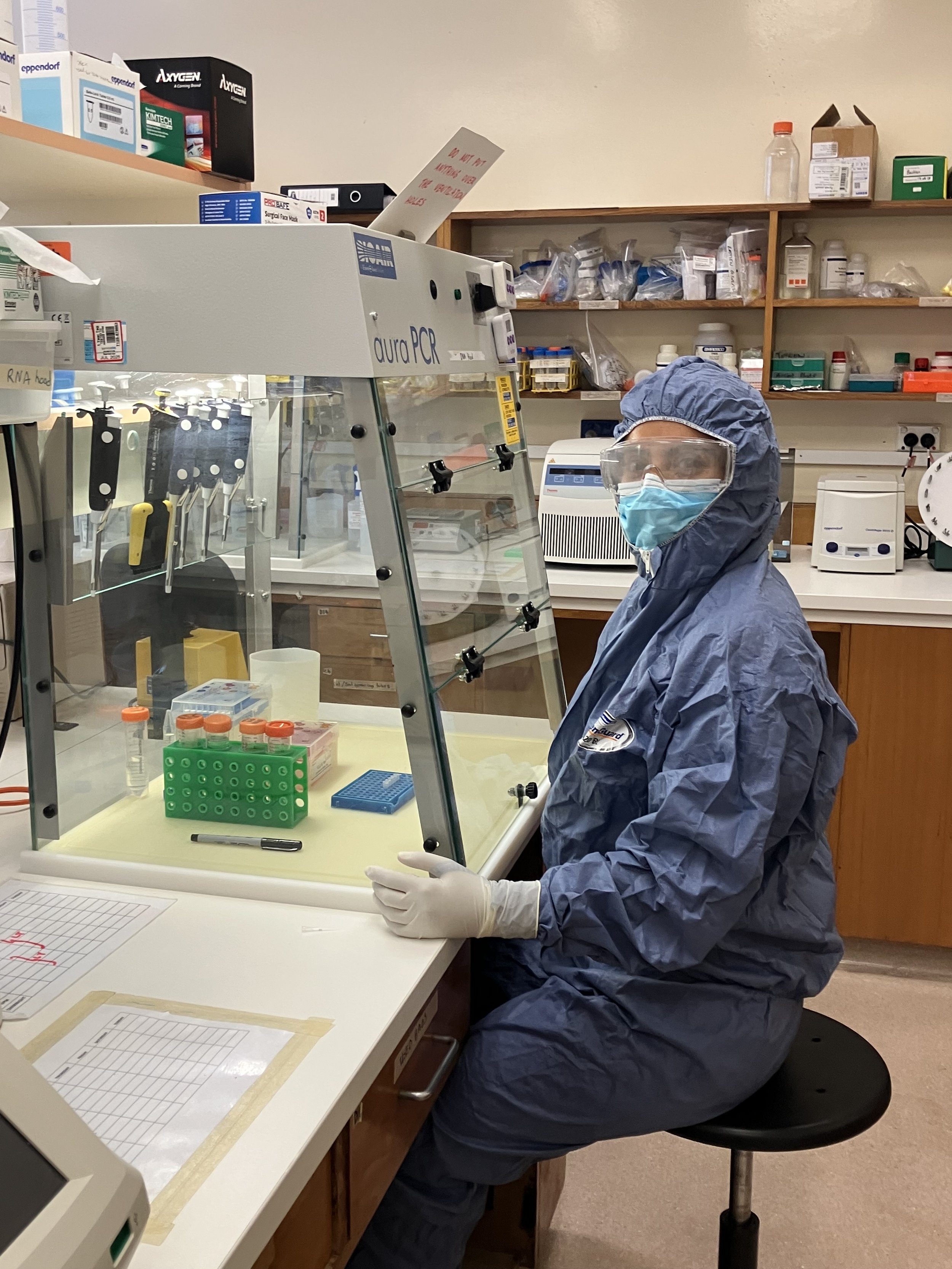
Dr Vilma Pérez uses environmental DNA techniques to understand when and how environments have changed and responded to disturbances
A fascinating new project now has access to the specific computational resources required to build high resolution records of Australia’s changing ecosystems over the past millennium. The research will reconstruct Australian palaeoenvironments and biodiversity using metagenomic analysis of sedimentary ancient DNA collected from mainland Australia and the Torres Strait Islands as part of codesigned projects involving leading Australian researchers and Indigenous partner organisations. Streamlined bioinformatics analysis pipelines will be essential to process the large volume of samples expected to come in from this collaboration.
Sedimentary ancient DNA (sedaDNA) analysis is a transformative tool for studying past biodiversity and its responses to environmental, climatic, and human-induced change. The project aims to build capacity for the growth of sedaDNA research in Australia by automating bioinformatic analyses into a single Nextflow pipeline that can easily produce a robust and reproducible taxonomic profile of both modern and ancient target species found in sediment samples. BioCommons was keen to support the research with access to both ABLeS and our Australian Nextflow Seqera Service.
This project is part of the ARC Centre of Excellence for Indigenous and Environmental Histories and Futures (CIEHF) which seeks to create a lasting impact by integrating Indigenous and Western knowledge frameworks to model environmental, cultural, and historical change in Australia over the past millennium and into the near future.
Dr Vilma Pérez is an environmental microbial ecologist at the Australian Centre for Ancient DNA, The University of Adelaide, who can now access the national computational infrastructure she needs for her research after being onboarded to BioCommons’ ABLeS and Seqera services. Vilma's expertise in using environmental DNA techniques to understand when and how environments have changed and responded to disturbances will be put to good use in CIEHF’s novel genetics research program.
Led by CIEHF Chief Investigator Assoc Prof Ray Tobler from the Evolution of Cultural Diversity Initiative at the Australian National University, the research program will use high-resolution landscape genomic analyses of selected Australian native flora and fauna, as well as ancient DNA recovered from archaeological sediments (sedaDNA).
This work will help reconstruct past Australian ecosystems to understand how biodiversity, from microbes to plants and animals, has changed over time, and how it has responded to environmental shifts, including Indigenous Australian landscape management practices that have helped care for Country for thousands of years.
Gaining access to the right computing infrastructure is one thing, but appropriate computing and data management mechanisms are needed to ensure that Indigenous genomic data resources are ethically managed to the benefit of Indigenous Australians. Mutual partners, Bioplatforms Australia, were able to connect CIEHF with colleagues at the National Computational Infrastructure (NCI) who are working with the National Centre for Indigenous Genomics (NCIG) to host their sensitive sequencing data. Given Indigenous genetics research requires unique ethical approaches, NCIG is leading the way in building a genome resource for the research community under Indigenous Governance and will no doubt have many insights to share.
As part of our ongoing support for CIEHF, Dr Ziad Al Bkhetan, Product Manager - Bioinformatics Platforms at BioCommons, and Dr Kelly Scarlett, Manager - Partnerships and Engagement at Bioplatforms Australia will participate in an upcoming sedaDNA workshop hosted by CIEHF researchers at the University of Adelaide.
This workshop sits within the Genomics research stream which is part of a suite of nine chosen to ensure a holistic, interdisciplinary approach. Find out more about how CIEHF’s research streams are addressing unique environmental, cultural, and historical complexities of Australia through an integrated approach, leveraging both Indigenous knowledge systems and researcher’s fields of expertise.
Knowledge sharing enABLeS computational research across the life sciences
The ABLeS User Group Meetings provide opportunities to come together to share knowledge, offer tips, ask questions or give feedback.
ABLeS (Australian BioCommons Leadership Share) supports groups with their shared data-driven bioinformatics needs, who bring with them a wide range of computational research programs. The research groups benefiting from the program wouldn’t normally have an avenue to share insights and learn from each other’s experiences.
The ABLeS program now includes more than 250 registered participants, representing more than 50 Australian research institutions and a wonderfully diverse array of research projects. The ABLeS User Group Meeting offers opportunities to come together to share knowledge, offer tips, ask questions or give feedback.
Held twice a year, the ABLeS User Group meeting includes presentations from researchers about how they are making use of their allocated computational resources, alongside updates on pertinent developments at both of the Australian peak computational facilities, Pawsey and NCI. This online forum is also a chance to ask questions or provide feedback on how ABLeS can be improved to help different researcher needs.

A poll at the latest User Group meeting suggested an octopus mascot for ABLeS!
At the last meeting, users heard from three different researchers whose projects receive ABLeS resources:
Computational Structural Biology Node, Dr Keiran Rowell (UNSW)
The Effect of a Mediterranean Diet on Blood DNA Methylation Profiles in Pregnant Women, Grace Tavelli (The Kids)
Rare Disease Genetics and Functional Genomics, Assoc Prof Gina Ravenscroft (Perkins Institute)
Given that it was the inaugural ABLeS User Group Meeting, the event opened with a fun activity to find a mascot for the ABLeS service. The most popular option amongst the 39 people attending was a friendly octopus. The ABLeS team is still trying to decipher any hidden message in that choice! Other interesting results from the poll were that the majority of participants joined from NSW and WA, and two thirds of those users were working on non-human species.
The next ABLeS User Group Meeting will take place online on 2 June 2025. Registered users of ABLeS should keep an eye on their inbox for their invitation to attend.
If you aren’t yet registered for ABLeS, you can find out more in this 10 min video explainer or jump straight into the ABLeS documentation.
ABLeS (Australian BioCommons Leadership Share) was established in 2021 to support data-driven bioinformatics. Australian BioCommons partners with Bioplatforms Australia, National Computational Infrastructure (NCI), and Pawsey Supercomputing Research Centre (Pawsey).