
As part of a week-long international engagement program, BioCommons brought together research data infrastructure experts from the USA, Finland, New Zealand and across Australia. The Human Genome Informatics division at BioCommons hosted Prof Robert Grossman, University of Chicago, the founder and lead of the Gen3 platform, to strengthen the collaborative and technical capability required to build world-class human genomics and biomedical data infrastructure in Australia.
Participants engaged in a series of strategic discussions and technical demonstrations focused on solving the complex challenges of data commons development, federated data access, security and governance frameworks, and international interoperability initiatives.
Reflecting on the growing importance of research data infrastructure, Prof Matthew Watt, Associate Dean Research at the University of Melbourne’s Faculty of Medicine, Dentistry and Health Sciences, noted that ‘well-designed data ecosystems are no longer optional - they are foundational infrastructure for modern biomedical discovery.’
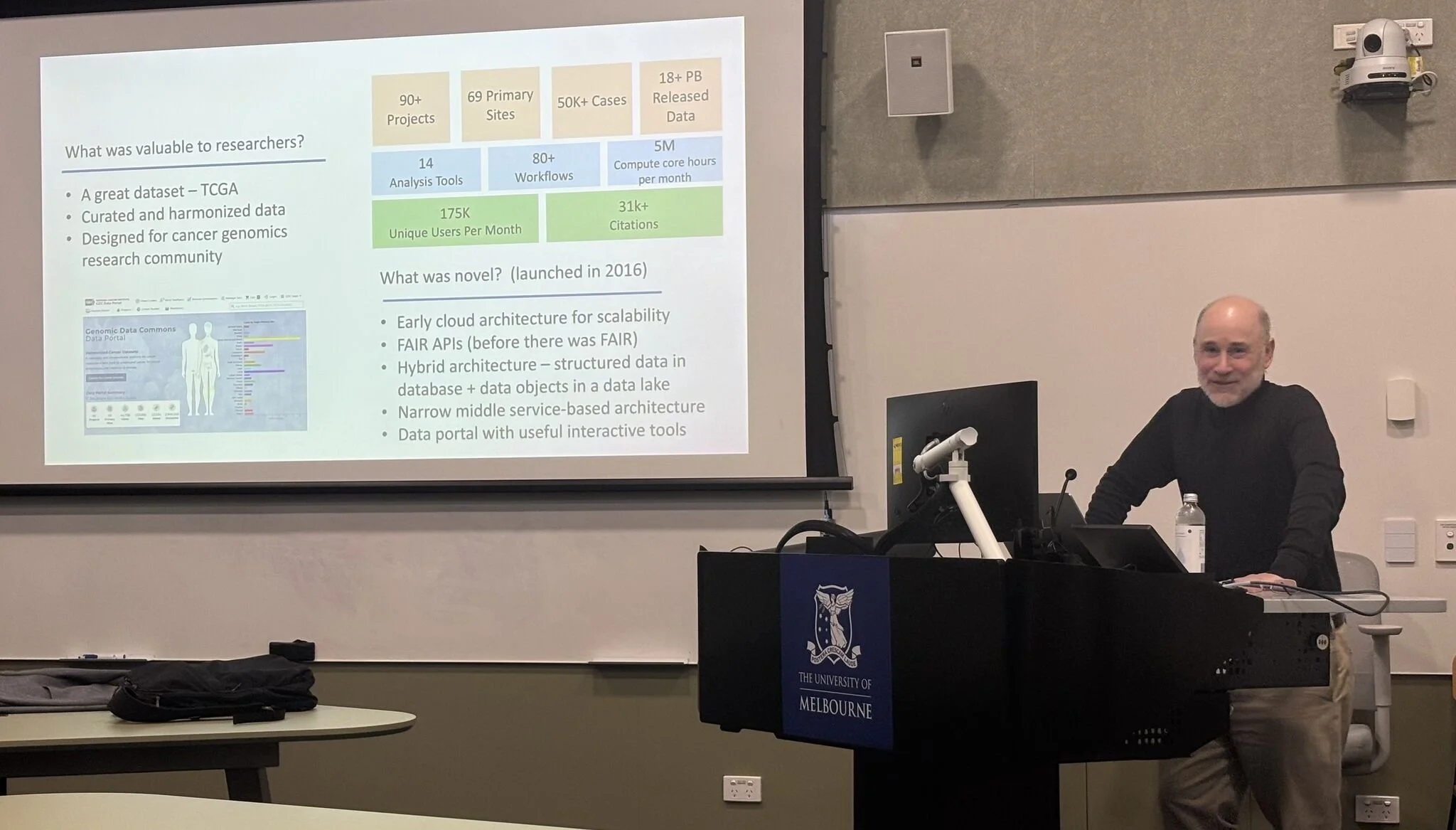
Prof Robert Grossman presenting during his seminar at the University of Melbourne
A particular highlight of the week was a seminar, ‘In Praise of Midscale Language Models and AI Commons and Their Applications to Biology, Medicine and Healthcare’, which sparked significant interest in how secure infrastructure can support the next generation of AI-driven biomedical research.
The discussions highlighted the value of strong international collaboration in advancing secure, scalable, and interoperable approaches to genomics and health data sharing, while also strengthening relationships across the global research infrastructure community. Participants noted the high quality of strategic conversations, which not only strengthened relationships but also reaffirmed Australia’s position as a leader in deploying these sophisticated systems.
How is Gen3 utilised in Australian human genomics research?
The Gen3 platform provides a robust framework to receive, manage, and describe massive datasets, allowing them to be shared securely with authorised users. It is the technology behind numerous US National Institutes of Health (NIH) projects that house data from hundreds of thousands of samples.
BioCommons has successfully led the implementation of Gen3 platforms for several landmark national projects, demonstrating our capability to adapt global best practices for the Australian research landscape. These include:
OMIX3: Led by the University of Melbourne, OMIX3 utilises mass spectrometry to enable the parallel collection of proteomics, metabolomics and lipidomics data, and is the first successful implementation of a Gen3 platform outside of the USA.
Australian Cardiovascular disease Data Commons (ACDC): Led by the Baker Heart and Diabetes Institute, ACDC provides a secure, Gen3-powered infrastructure to pool data from 400,000 individuals across 18 clinical cohorts.
Biological Psychiatry Data Commons (BPsych-DC): Led by the Consortium for Preclinical Psychiatric Research, providing a national digital infrastructure to harmonise multi-omics data across cellular, animal and human psychiatric models, bridging the gap between discovery and clinical impact
Prof Bernard Pope, GUARDIANS Program Lead and A/Director (Human Genome Informatics) at BioCommons, reflected on the highlights of the week:
‘Data commons are the backbone of collaborative genomic research. The ability to securely connect, govern, and analyse large-scale datasets is increasingly critical for translating research discoveries into meaningful health and clinical impact.’
‘The success of projects like OMIX3 and ACDC is built on years of shared expertise between our team and the architects of Gen3. By hosting international experts through the GUARDIANS program, we are ensuring that Australian researchers have access to the same secure, scalable technologies that power the world’s largest genomic projects.’
Take a closer look at the GUARDIANS Program: https://www.biocommons.org.au/guardians
