
News
Subscribe to the Australian BioCommons monthly newsletter or read previous editions
Latest tech unlocks deep sea mysteries hidden in museum collections
Researchers from the Museums Victoria Research Institute have constructed one of the largest distributional and evolutionary DNA datasets seen in marine science and now seek to answer questions such as: Where and when did deep sea life begin? How did it spread throughout the oceans that cover over 70% of the Earth’s surface?

A rare brittle-star from deep-water off New Caledonia. Photo by Caroline Harding/Museums Victoria.
One of the largest distributional and evolutionary DNA datasets seen in marine science has been constructed by researchers from the Museums Victoria Research Institute. They have spent 15 years sequencing deep-sea fauna from museum collections across the globe. Shedding new light on our understanding of deep sea life, the research program seeks to answer questions such as: Where and when did deep sea life begin? How did it spread throughout the oceans that cover over 70% of the Earth’s surface?
The pursuit of big ambitions like mapping patterns of deep-sea biodiversity across the globe creates massive datasets. But these large datasets come with substantial computational requirements, which are not always available. Dr Tim O’Hara, Senior Curator at Museums Victoria, is well aware of this challenge:
“We didn’t have in-house access to the computing infrastructure required to process such large amounts of raw genetic data. We had to find the computing power we needed to process our raw genetic data, create phylogenies (trees of life), and run models that explore evolutionary and biogeographic relationships.”
Tim uses museum collections to answer large-scale questions about the distribution of seafloor animals around the globe, and leads the museum’s brittle-star (ophiuroid) research program. Ophiuroids are widespread on seafloors across the globe, making them an ideal model species to understand distribution patterns across the last 100 million years.
“We extract nuclear and mitochondrial DNA to construct an enormous tree of life, which now contains 2700 samples. This enables us to determine where species originated and spread across the oceans. Since no one has really achieved this before, we are expecting to make a series of novel and interesting discoveries.”
Tim’s team at Melbourne Museum requested support through the Australian BioCommons Leadership Share, or ABLeS. The program was specifically designed to support researchers like Tim, who don’t have local access to the digital infrastructures they need and aren’t regular users of high performance computing facilities. By providing access to appropriate and scalable bioinformatics resources, ABLeS empowers researchers without a background in computational research and who are not currently supported by merit-based allocation schemes to conduct their research
Read more about the technical details of the support ABLeS provides The Ophiuroid Project or read more about Tim’s research.
Phylogenetics collaboration takes researchers back to basics with new training
A new online tutorial is taking researchers back to basics to uncover the principles of phylogenetics and how tree-building methods work thanks to a longstanding collaboration between Professor Michael Charleston from the University of Tasmania and Australian BioCommons.

Charles Darwin's first sketch of an evolutionary tree. Source: Wikimedia commons
A new online tutorial has been created to take researchers back to basics to uncover the principles of phylogenetics and how tree-building methods work. A longstanding collaboration between Professor Michael Charleston from the University of Tasmania and Australian BioCommons has delivered this self-guided tutorial featuring videos and hands-on exercises. To maximise its impact, the resource was tailored specifically to be shared globally via the Galaxy Training Network, and will form the basis of an upcoming live training workshop.
Using real-life data, and tools available in Galaxy and SplitsTree, the tutorial demonstrates the principles behind a variety of methods used to estimate phylogenetic trees from aligned sequence data or distance data. With a conversational style Michael discusses why phylogenetics is important, unpicks phylogenetics terminology from the roots to the tips and explains concepts such as multiple sequence alignment, how alignments are used to build trees, and phylogenetic networks.
Having the materials readily available online is already bringing benefits to Michael’s teaching at the University of Tasmania.
“Having the materials online with exercises in Galaxy is just fantastic for my university teaching. It means that students don’t have to take notes and frees them up to engage more deeply in class. Once they understand the concepts they can easily try out basic phylogenetic analyses and see how the tools work without needing to know how to code. ” - Professor Michael Charleston, University of Tasmania
Michael first created the concept of a workshop that explained the principles behind building phylogenetic trees in 2019 when experts from around Australia came together to consult on his materials ahead of a national workshop. Rather than providing an introduction to the topic, mathematician Michael’s deeper explanations of the underlying theories for people already creating phylogenetic trees found a unique niche. After amassing 24,000 views on the BioCommons YouTube channel, the need for an updated standalone tutorial was obvious.
Michael worked closely with the BioCommons training team over the last year and a half to develop this tutorial by tailoring and refreshing the materials and activities for the self-contained and easy to use Galaxy platform. This activity is part of the BioCommons’ commitment to making our training materials FAIR.
Try out the Phylogenetics: back to basics tutorial in the Galaxy Training Network.
Or if you prefer live training, join us for a workshop based on the tutorial in July.
Training with real-world genetic data to advance Australia’s urgent conservation goals
A diverse group of researchers converged at The University of Melbourne this month to work through their unique bioinformatics challenges under the guidance of The University of Auckland’s Dr Katarina Stuart.
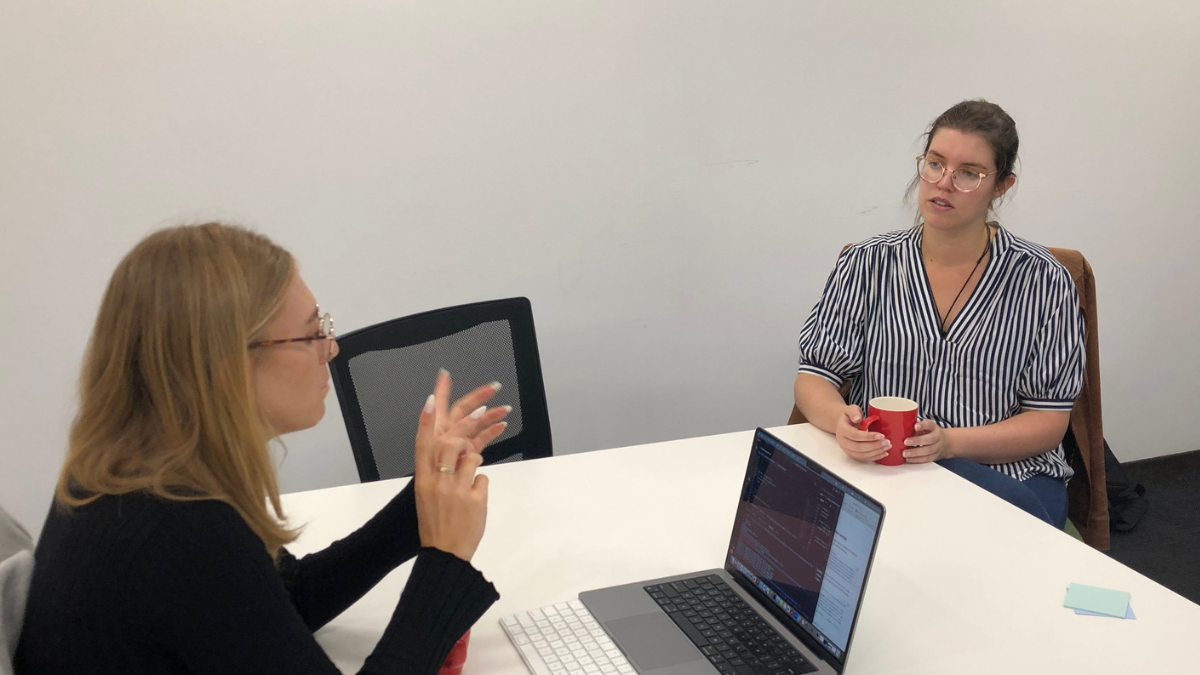
Katarina (right) working closely with Mikaeylah (left).
A diverse group of researchers converged at The University of Melbourne this month to work through their unique bioinformatics challenges under the guidance of The University of Auckland’s Dr Katarina Stuart. The genetic outlier analysis workshop invited participants to bring along their own datasets to analyse over two days. Working with real-world data offered attendees the opportunity to apply new techniques in their field, learn how methods may need to be tweaked, and importantly progress their research.
Mikaeylah Davidson, a PhD Candidate in the Faculty of Science’s One Health Research Group at The University of Melbourne, relished the opportunity to bring her own data:
Being able to engage with the data I'm actively working on was incredibly beneficial, as it provided me with the chance to seek assistance in troubleshooting issues I am currently encountering, as well as gaining insight into recurring challenges and how to address them effectively. This hands-on approach was incredibly helpful.
Mikaeylah’s research explores the potential of selective breeding as a tool to combat wildlife disease. While selective breeding has been used extensively for genetic improvement in domesticated animals, its application in conservation remains largely unexplored. Mikaeylah’s PhD is focused on the Southern Corroboree frog, which is critically endangered due to the introduction and spread of the deadly amphibian chytrid fungus.
Aiming to leverage the existing conservation breeding program based within the zoos, she hopes to identify phenotypic and genetic traits associated with resistance to the chytrid fungus. If successful, this could pave the way for the implementation of a selective breeding program aimed at reducing detrimental alleles and amplifying beneficial ones within the population. Ultimately, the goal is to breed Southern Corroboree frogs that have a heightened tolerance to the fungus, enabling their survival in the wild despite the presence of chytrid.
The highly practical workshop stepped through the use of command line programs, while providing the opportunity to ask questions of their use, functions and applicability. Multiple genetic outlier analysis methods were explored while learning how and when different methods should be used. The pros and cons of different methods helped explain which are best suited to different data types. This type of information can be very difficult to find without experience, or many hours of working though various software and protocols, according to Elliott Schmidt, a PhD Candidate from James Cook University:
I believe that this workshop has saved me many hours of troubleshooting my genetic outlier analysis. Coming away from the workshop with example scripts composed using my own data has given me confidence that my approach to analysing my data is appropriate and efficient, and can now be completed independently.
Elliott flew down from Townsville to progress his research into how evolutionary perspectives can be incorporated in conservation of a coral reef fish. His PhD project explores how different populations of a coral reef damselfish, Acanthochromis polyacanthus, distributed across the Great Barrier Reef may respond differently to warming ocean temperatures. He’s tackling this question by investigating local adaptation, differences in developmental plasticity, and population genetics. By incorporating physiological experiments with population genetics Elliott hopes to identify potential differences in vulnerability to warming temperatures between different populations as well as provide explanations for these differences via genetic analysis.
Hearing about the challenges faced by researchers working with different datasets was a highlight, and many of the 11 participants reported valuing the opportunity to engage in discussions with peers. Working intensively with their expert trainer and each other’s data, their ability to query and interpret varied datasets was honed. Mikaeylah particularly enjoyed the highly interactive elements:
Working through our real data enabled me to further my understanding of my own, while also offering insights into the challenges others face with their datasets. I found the exchanges on results interpretation very helpful, and also interesting, as they allowed me to learn how to interpret diverse datasets and troubleshoot different issues which may arise.
This workshop was part of a series of events made available through a collaboration between the Genetics Society of AustralAsia (GSA) and Australian BioCommons. There was also an online genetic outlier analysis workshop held in February, and another in person workshop will be held this July in conjunction with the GSA2024 Conference in Sydney. The workshops were supported by GSA’s Workshop Support Program that aims to help share knowledge and/or exchange ideas across genetics.
More information on the next hands-on workshop: Genetic outlier analysis (Sydney).

Introducing the Australian Tree of Life Informatics Capability
This program will equip researchers and decision-makers with the tools to leverage cutting-edge genomics technologies to more effectively manage and safeguard Australia’s precious biodiversity and agricultural resources.
Powering research and decision-making for Australian biodiversity and agriculture
Reposted from Bioplatforms Australia

The Australian Tree of Life Informatics Capability is establishing a new digital framework to bridge the gap between the generation of genomics data and its application in on-the-ground actions. This program will equip researchers and decision-makers with the tools to leverage cutting-edge genomics technologies, enabling them to more effectively manage and safeguard Australia’s precious biodiversity and agricultural resources.
Australia is one of a few megadiverse regions in the world. It is home to around 10 percent of the world’s species, with around 80 percent of Australia’s native species not occurring naturally anywhere else. National strategic plans for biodiversity and biosecurity emphasise the importance of making informed, data-driven decisions to support this unique environment and the primary industries that flourish in it.
Various endeavours, including the Bioplatforms National Initiatives, are currently producing essential genetic and genomic data, such as reference genomes. Whole genome sequencing acts as a cornerstone resource, facilitating discoveries such as identifying previously unknown species, uncovering novel genes for innovative applications, and understanding organism functions in nature and agriculture, and exploring their variability and interactions.
Generating genomic data for all relevant Australian species, and making it relevant to real-world application is an immense undertaking, requiring that we intensify our efforts. Our challenge is to develop a system that continues to foster enhanced collaboration, expedites data generation, assembly and analysis, and provides specialised platforms tailored to effectively deciphering this data for real-world use.
The Australian Tree of Life Informatics Capability is addressing this challenge by establishing two new infrastructures:
1. The Australian Tree of Life – Genome Engine
The Genome Engine will accelerate the assembly and annotation of referential genomic data for species relevant to Australia. Building on existing Bioplatforms investments in data generation (via National Initiatives) and data analytics services (via Australian BioCommons), it will allow Australian species to be studied from molecular to population scales. Researchers will be provided access to automatically produced genome assemblies, annotations and published Genome Notes soon after the raw sequencing data has been created.
The infrastructure will leverage approaches developed by the UK-based Wellcome Sanger Institute’s Darwin Tree of Life project and Galaxy infrastructure supporting the Vertebrate Genomes Project, bringing their workflows and methodologies to Australia.
2. The Australian Tree of Life – Applied Data Laboratories
Applied Data Laboratories will generate meaningful and actionable information for decision-makers based on genomic resources, such as those made available by the Genome Engine.
Applied Data Laboratories will be developed in consultation with end-user communities such as those involved with the Plant Pathogen, Pest Management, and Functional Fungi Bioplatforms National Initiatives. Our objective is to allow more researchers, industry and government professionals, and policy makers to harness the power of genomics to inform on-the-ground actions that secure Australia’s primary industries, nature, and biodiversity.
This work will build on a concept from the Threatened Species Initiative (TSI), where Bioplatforms, in partnership with the University of Sydney and RONIN, has invested in the development of the TSI Biodiversity Portal. Scheduled for release in mid-2024, the Portal will empower threatened species managers to sequence and interpret population genetics data, generating reports tailored to inform species recovery actions.
Together, this digital capability will help to bridge the gap between generating and applying genomic data, significantly improving Australia’s capacity to leverage recent advances in next-generation sequencing. This will play a crucial role in preserving our unique biodiversity and safeguarding Australia’s primary industries, food systems and environments.
This digital research infrastructure initiative is enabled by the National Collaborative Research Infrastructure Strategy (NCRIS).
For further information and updates, please contact:
Dr Nigel Ward – A/Director – Platforms, Australian BioCommons
Sarah Richmond – General Manager Science Program, Bioplatforms Australia
Empowering life science researchers: New software on Galaxy Australia breaks down barriers
Galaxy Australia has been updated with two powerful software packages installed and fully subsidised for Australian researchers to use.

Galaxy Australia has been updated with two powerful software packages installed and fully subsidised for Australian researchers to use.
Specialised bioinformatics tools, like the newly available Fgenesh++ and Cell Ranger, are frequently required for life sciences data analyses. Individual researchers are often unable or not confident to accept licensing conditions and associated charges, or are unable to upload a licence file. Now, Galaxy Australia has opened the door to use these proprietary bioinformatics tools by negotiating licences which come at no additional cost to the user. Researchers using Galaxy Australia also receive fully subsidised access to a national high-performance computing network, enabling complex data analyses to be performed in the user-friendly web interface.
Fgenesh++ is a bioinformatics pipeline for automatic prediction of genes in eukaryotic genomes with extensive guidance available. It produces fully automated genome annotations of a quality similar to manual annotation, and is extremely fast compared to some other automated genome annotation pipelines. In response to requests from the genomics community, BioCommons licenced Fgenesh++ from Softberry and provide fully subsidised access for Australian-based research groups and research consortia via our Fgenesh++ Service. Now, individuals who would like access can also apply to use it through Galaxy Australia.
The second software package, Cell Ranger, was added to Galaxy Australia following requests from the single cell omics community. Cell Ranger is a set of analysis pipelines that count how many times something occurs within a cell. It processes 10x Genomics Chromium single cell data to align reads, generate feature-barcode matrices, perform clustering and other secondary analyses, and much more (see the list of example workflows and supported libraries). Cell Ranger contains in-built reference genome data, and can be integrated with the interactive CellXgene environment in Galaxy Australia for data visualisation.
If you are an Australian researcher interested in using either of these powerful software packages via Galaxy Australia, apply for access today.
Have your say on new activities to improve data submission to global repositories
We’re collaborating with the European Bioinformatics Institute (EMBL-EBI) to improve submission to data repositories. With a range of activities in the works, we want to hear what you’d like us to support and how you might participate.

Submission of 'omics data and associated contextual metadata to global data repositories is considered best practice when it comes to long term preservation and subsequent findability and reusability of these data.
Our community consultations have teased out some of the challenges faced by Australian-based researchers in the submission process. A summary of the challenges in data and metadata submission and a set of recommendations for how to address these challenges has been published, Omics Data Publishing to International Repositories from Australia.
Australian BioCommons is collaborating with the European Bioinformatics Institute (EMBL-EBI) to address these challenges, and we are currently investigating the value of bringing EMBL-EBI / European Nucleotide Archive (ENA) team members to Australia for a variety of events (in early 2025) including:
Training workshops for Data Submission:
How to submit data to ENA, including:
Genome assemblies and annotations
Metagenome-assembled genomes (MAGs)
OTU/eDNA-derived data
Sessions to provide feedback on existing documentation:
An opportunity to provide feedback directly to the ENA team on existing documentation for data submission, retrieval, and analysis. Your insights and suggestions will help improve the user experience and address common pain points.
Hands-on sessions to trial community-driven documentation design:
An opportunity to work alongside the ENA team and fellow researchers in a collaborative effort to trial community-driven documentation design for the data submission process. Your direct involvement will contribute to improving the usability, and accessibility of EMBL-EBI resources.
We’d love to know what you think of these ideas, and whether you’d like to participate by completing the Expression of Interest form by 14 June 2024.
Are you ready for AI?
There’s never been a better time to up-skill on machine learning and AI. We’ve summarised our upcoming training events and other national opportunities to get you started.

There’s never been a better time to get hands on with machine learning and AI, with two upcoming BioCommons events on this topic.
On 8 May, Dr Michael Kuiper from the CSIRO presents a webinar on how AI tools can be used to accelerate research. Michael will explore how AI is reshaping scientific exploration and innovation, and how it can accelerate research processes, from data analysis and code writing to hypothesis development
Then on 11 June, Dr Ben Goudey from The Florey leads a hands-on workshop on Machine Learning in the Life Sciences. Using R-based machine learning workflows, this workshop demonstrates what machine learning is, its advantages and disadvantages and the types of scenarios where it may be the right tool for the job.
Nationally, there are many more opportunities to learn about and shape the future of machine learning and AI for digital research applications:
CSIRO’s National Artificial Intelligence Centre provides additional resources, workshops and initiatives to guide, nurture and inform the use of AI
The ML4AU Community of Practice, co-facilitated by ARDC and Monash Data Science and AI Platform, enables collaborative initiatives and provides training on emerging needs for ML capabilities and expertise in research
AI and Comms Community of Practice provides a forum to discuss and trial AI tools for science communication in research.
Community forum helps to shape research infrastructure for computational proteomics
The “Connections in Computational Proteomics” forum recently brought together local and international experts to network and discuss the latest trends, challenges and advances in computational proteomics.

The “Connections in Computational Proteomics” forum recently brought together local and international experts to network, discuss and learn. Capitalising on the convergence in Melbourne for the annual Lorne Proteomics conference, 27 researchers and service providers discussed the latest trends, challenges and advances in computational proteomics.
The forum was open to all, plus hosted the first in-person gathering of the Proteomics Bioinformatics community. BioCommons engages with this coordinated interest group to collaboratively address community-identified challenges, including resolving gaps in the digital infrastructure available for proteomics research. The open invitation was taken up by international visitors, students and plenty of new voices who joined the ongoing conversations.
Participants explored how they could tackle challenges inherent in computational proteomics, and shared how they are addressing current problems. Dr Nikeisha Caruana, Research Fellow in Bioinformatics at the Bio21 Institute, said that:
The forum provided an environment where those in computational proteomics and the surrounding fields could come together and brainstorm solutions to current technological obstacles. The field is relatively new professionally and many of us are scattered around Australia, and it created a fantastic environment for networking and building potential collaborations.
Paula Burton, CEO and Co-Founder of Mass Dynamics, enjoyed “talking all things computational proteomics” at the forum, especially the “great talks by [international experts] Stefan Tenzer and Mathias Wilhelm, and the vibrant discussions had on the challenges we’re facing as a field.”
The group collaboratively identified several key challenges related to proteomics experiments, particularly in terms of ensuring experiments are well-designed and reproducible. Output data must be clear, organised, and include metadata that provides sufficient context for others to reuse or repurpose the dataset.
Participants were offered a preview of the Galaxy Australia Proteomics Lab, a customised view of Galaxy Australia that provides rapid access to a range of sophisticated proteomics resources while retaining the full power of Galaxy Australia. The preview was “my favourite aspect of the forum,” according to Dr Rohan Lowe, Facility Manager of the La Trobe La Trobe Proteomics and Metabolomics Research Platform. Rohan particularly enjoyed “the chance to suggest improvements before it is fully launched for all Australian researchers to use." Stay tuned for more on Proteomics Lab in the coming months!
The forum closed with a discussion on the next steps for the Proteomics Bioinformatics community. The group have prepared a forum report, and are excited to get to work addressing the challenges they identified!
If your work is in computational proteomics or a related field, you are invited to join the conversation and start collaborating! Head to the Proteomics Bioinformatics webpage to learn more and get involved.
Support from the Australasian Proteomics Society (APS) for this community event is warmly acknowledged. BioCommons thanks the APS for inviting international guests, and for sharing the event details on the Lorne Proteomics conference registration page to assist in getting the word out.
Turning raw data into publication-quality graphics in a flash
Visualising complex statistical data is rarely a simple task. Learn how Lauren Carpenter leveraged Galaxy Australia to rapidly produce publication-ready heatplots of her survey data.

Visualising complex statistical data is rarely a simple task. Researchers frequently need to learn to use packages for complex visualisation software to produce high quality graphics - but there is an alternative. Recently, Lauren Carpenter, PhD candidate at the University of Queensland, leveraged Galaxy Australia’s web interface to rapidly produce publication-ready heatplots of her survey data. Galaxy’s promise of ease of use held true for Lauren.
I was able to quickly and simply visualise my data, and easily controlled the stylistic elements that influenced the readability of the heatmaps. Galaxy saved me a lot of time, it was user-friendly, and allowed me to produce visually consistent heatmaps for different data sets in the same context.
Lauren’s research on the employability of first year science undergraduates is heavily text based, which can be challenging to translate into a digestible figure. After analysing her data in NVivo, she used coding packages such as R Studio to visualise her data. Despite already having experience in R, Lauren found herself losing large chunks of her valuable time watching online tutorials and reading guides, and struggled to prevent data point clustering. Lauren needed a customisable tool to ensure that her smaller data points remained visible in the final output.
Rather than continuing down this time-consuming path in R, Lauren asked her PhD colleagues at UQ’s School of Chemistry and Molecular Biosciences for advice. After their recommendation of Galaxy Australia as ‘a very user-friendly program’ which they frequently use to analyse their transcriptomics and genomics data, Lauren decided to use Galaxy herself for the first time with great success.
I found the variables that worked for my data through a short trial-and-error process. I would definitely recommend Galaxy Australia to other researchers, as I found it intuitive, and I was able to quickly achieve the heatmap visualisation that I had originally envisioned.
Galaxy Australia contains popular data visualisation tools such as Krona and Circos plots, and contains a framework for further visualisation options. All these tools, plus powerful computing resources, are fully subsidised for Australian researchers to use without requiring prior programming experience.
Open up Galaxy Australia and get started visualising your data today!
From corals to the classroom: an interview with Dr Ashley Dungan
We chat with Ashley to find out more about her research and why she chose to work with the National Bioinformatics Training Cooperative to uplift the skills of fellow researchers.

It can be a struggle to keep up with the latest bioinformatics tools. Researchers have diverse needs and limited time to shop around for new techniques to analyse their data, let alone troubleshoot a new platform. What better way is there to learn a new approach than from researchers actively using useful tools in their own work? BioCommons collaborates with experts to deliver training workshops that help researchers glean insights and practical tips directly from their peers.
Dr Ashley Dungan, Research Fellow at The University of Melbourne, worked with BioCommons to train researchers from 22 different Australian institutes and organisations to use the bioinformatics platform, Quantitative Insights Into Microbial Ecology 2 (QIIME 2). Ashley originally developed the workshop for a local audience, alongside Melbourne Bioinformatics staff Dr Gayle Philip and Dr Vicky Perreau. Given the success of this all women team, BioCommons was keen to assist them to bring the training to a national audience. You can read about the impact of that training in our related story.
We interviewed Ashley to find out more about her research and why she chose to work with the National Bioinformatics Training Cooperative to uplift the skills of fellow researchers.
Ashley, can you tell us a little bit about your research?
I’m a Research Fellow in conservation microbial ecology. Broadly, I’m interested in the functions of bacteria in a range of systems with the end goal of manipulating those communities to achieve a better outcome for the host/system. To put this in the context of conservation, I’m interested in protecting our biodiversity and preventing the loss of species and ecosystems by providing animals with beneficial bacteria, or probiotics. So far, most of my research has been in coral-associated bacteria.
What motivates you to provide training to other researchers?
I didn’t start off my scientific career as a microbiologist. When I joined my PhD program, the focus was on coral probiotics and I was daunted by the prospect of having to do any bioinformatics. I found that most training resources were written by experts in a language that was really only available to other experts. Where was the dummies guide? Other resources were hidden behind a paywall or required attendance somewhere in Europe or North America. The training I was able to attend wasn’t immediately useful to me, or I’d have to fully rewrite the code (which I wasn’t skilled enough to do).
I was lucky that a fellow PhD student at the time (Dr Leon Hartman, who now works at the Walter and Eliza Hall Institute of Medical Research) walked me through everything and gave me lots of code. But the reality is that most students/scientists won’t have this type of resource. So I wanted to come up with a training solution that:
Was written for biologists by biologists, avoiding computer science jargon wherever possible
Was free
Could be attended in-person, virtual, or do it yourself
Where attendees could immediately run the code for their own use.
What’s the best part of training other researchers?
Data analysis isn’t easy but when you can see a community of like-minded people together, that’s powerful. There is nothing more satisfying than giving people the confidence to incorporate new techniques and ask new questions in their research. I’m proud of the team that put this together – it really wouldn’t have happened without Gayle and Vicky. And how cool is it that we are women doing microbiology and bioinformatics! The odds of that happening, even in 2024, in a bioinformatics workshop are still exceedingly low but we are committed to breaking down barriers for women in science.
How did you scale your training to a national audience?
Gayle and Vicky helped me create the QIIME 2 workshop that we ran locally for University of Melbourne participants. But we wanted to bring this training to all Australian researchers, and ensure that anyone could attend virtually. I worked closely with Dr Melissa Burke (Training and Communications Officer at BioCommons) to adapt the workshop to ensure it was fully accessible online. Melissa then coordinated a half-day workshop where we had 45 participants from 22 different institutes/organisations around the country join us, including 60% who identified as female or non-binary. Working with Melissa and the National Bioinformatics Training Cooperative was a fantastic experience and I highly recommend that others interested in providing bioinformatics training get involved.
What’s next for you?
I’ve now trained Laura Geissler (my PhD student) to run the QIIME 2 workshops and she will take over the sessions hosted by Melbourne Bioinformatics. Looking ahead, all my fellowship applications now include creating a new workshop alongside doing primary research. First up, I’d like to create workshops focused on whole genome assemblies and metagenomics.
You can learn more about the BioCommons national training program on our website, or read how Ashley’s QIIME2 training led to an Australian first in respiratory disease research.