
Contributing to open and accessible training with 500+ bioinformatics resources
Did you know that an international community has been coordinating the creation of freely accessible educational data analysis training resources for over a decade? This sustained stewardship from the Galaxy community has resulted in a collection of over 500 tutorials covering 35 topics that have been written, reviewed and maintained by people committed to open and accessible training.
What do these training resources cover?
Galaxy Training is a collection of tutorials developed and maintained by the worldwide Galaxy community. There have been 511 contributors, including the Hall of Fame: Australian BioCommons team who have contributed to 37 tutorials in support of life sciences computation. The library of tutorials available in Galaxy Training cover a wide range of scientific fields including genomics, climate science, ecology, statistics, machine learning and more. The resources combine videos, slides and worked examples that are accessible to everyone to use in their own time. The Galaxy community also hosts a massive online training event online each year to provide a further layer of support to learners.
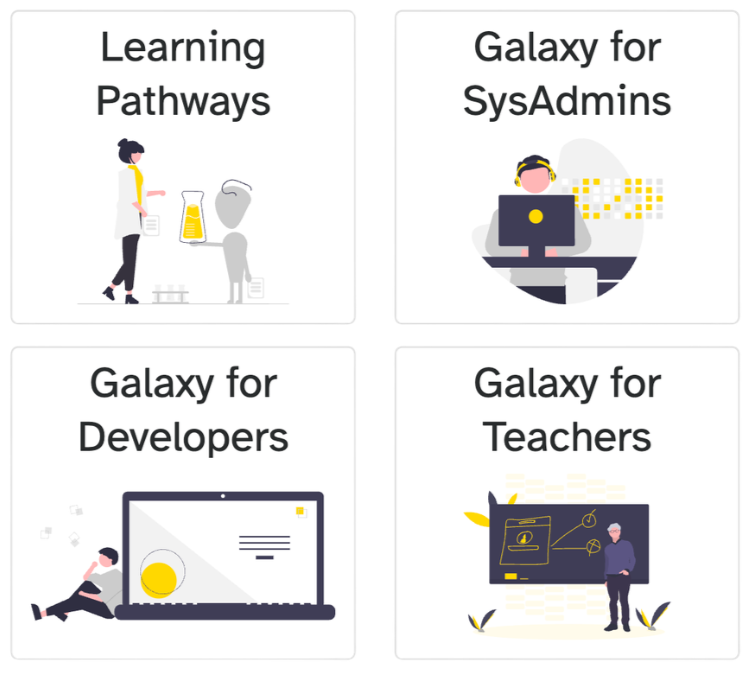
Different categories of training resources available
The group of BioCommons contributors work at Melbourne Bioinformatics, the University of Queensland, and QCIF Digital Research, supporting researchers through training and improvements to the Galaxy data analysis platform. The Galaxy Australia service is made available for Australian life science researchers to more easily perform their data analysis. The web-accessible platform offers fully-subsidised accessible, reproducible, and transparent computational biological research. The Galaxy Australia service contains over 2,000 bioinformatics tools (for genome assembly, annotation, epigenetics, metabolomics, metagenomics, proteomics, statistics, transcriptomics, variant analysis and visualisation) and over 220 reference datasets (e.g. publicly available genome builds).
There are now over 650,000 registered Galaxy users internationally, and the Galaxy Community is always encouraging new users to get more involved. There are lots of different ways to contribute to the Galaxy Training Network (GTN), from reporting suggesting tune-up opportunities as you step through the tutorials, all the way to creating new content you think would be useful to others. Contributions can be driven by an individual sharing a specific thing they developed in the hope that it can help someone else with a similar niche interest, or involve a large effort to coordinate big changes that will benefit a very large group of people. The integration of the Galaxy Training Network with WorkflowHub was made possible thanks to a collaborative effort between Australian BioCommons and the Galaxy Training Network and WorkflowHub teams. All Galaxy Training workflows are now registered with WorkflowHub, with workflows contained in every new tutorial automatically pushed to WorkflowHub.
Where can I access Galaxy Training resources?
Investigate the Galaxy Training workflows: Galaxy Training on WorkflowHub.
View a webinar introduction to using Galaxy Australia for different biological applications: No code, no problem: data analysis for biologists using Galaxy Australia - Dr Tiff Nelson and Dr Tristan Reynolds.
Register for the free and online Galaxy Training Academy 2026.
